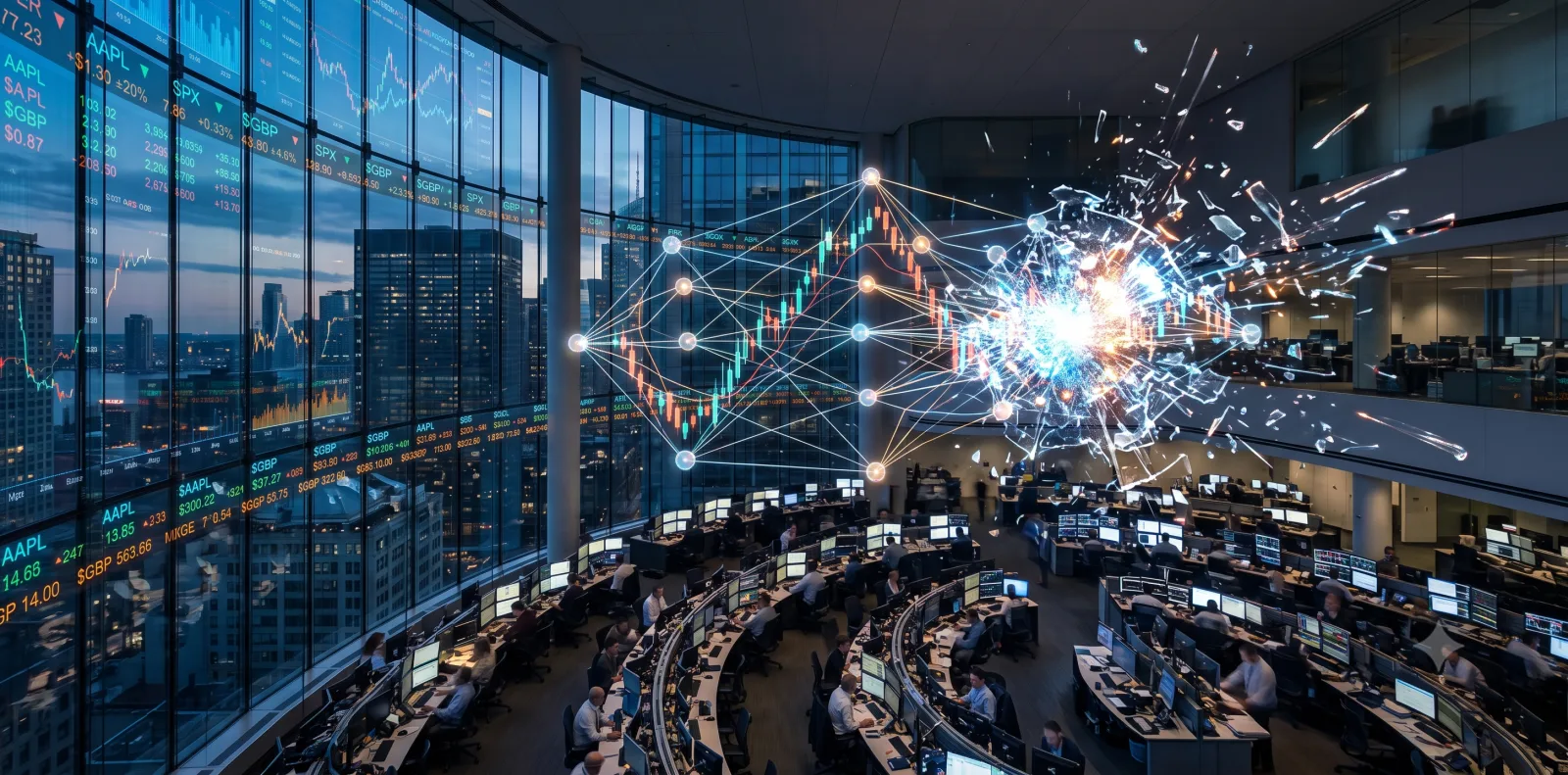
The $35bn AI Margin Call That Shook Hedge Funds
How the collapse of Leopold Aschenbrenner's Situational Awareness fund exposed the leverage and crowding beneath the 2026 AI rally — and why it matters for markets, quants and regulators.

For most of 2026 the fashionable worry about artificial intelligence in markets was philosophical: were valuations a bubble, and would the machines eventually replace the humans setting prices? In the last fortnight of July, a more prosaic question answered itself. A single fund that had ridden the AI hardware boom to a 439% gain lost the better part of $45bn in assets in barely three weeks, and did so in a stock market that was otherwise calm. The lesson was not about artificial intelligence at all. It was about leverage, crowding and the oldest reflex in finance: the margin call.
Executive summary#
Situational Awareness, the fund run by former OpenAI researcher Leopold Aschenbrenner, collapsed from roughly $45bn to about $10bn in assets during July 2026 after a pullback in semiconductor shares triggered escalating margin calls. Reported to have run gross leverage near 400% and concentrated in AI hardware names such as SK Hynix, Micron, Nebius and CoreWeave, the fund was forced into a distressed sale of its public book to Ken Griffin's Citadel to satisfy its prime brokers. The unwind rippled through the industry: systematic managers suffered their sharpest drawdown in a year, and prime desks demanded fresh collateral across crowded AI positions. Yet within days, markets staged a violent recovery. The episode is a case study in how funding liquidity, not fundamentals, can dictate the price of the market's most crowded trade.
What happened?#
Through the first half of 2026, few investors captured the AI theme more aggressively than Situational Awareness. According to reporting by CNBC, the fund had grown to roughly $45bn and was up about 439% through June on concentrated long positions in AI memory and infrastructure companies (CNBC, 31 July 2026).
That leadership reversed hard. As chip stocks rolled over in late July (a UBS basket of AI-spending beneficiaries at one point trailed a basket of AI-disruption "losers" by a record margin), the fund's leverage worked in reverse (Bloomberg, 29 July 2026). With gross exposure reported near 400%, a modest decline in the underlying shares was enough to erode the fund's equity cushion, prompting prime brokers to demand more collateral. Raising that cash meant selling into a falling market, which drove prices lower still and generated fresh margin calls. A painful drawdown became, in CNBC's phrase, a "deleveraging spiral" (CNBC, 31 July 2026).
The endgame was a forced sale. Working with prime brokers including Bank of America, Goldman Sachs and JPMorgan, the fund liquidated its leveraged public positions (SK Hynix and CoreWeave among them), selling a large public book to Citadel at a discount (CNBC, 30 July 2026). By early August, Citadel had reported one of its strongest months in years, in part on the strength of those purchases (CNBC, 5 August 2026). Bank of America chief executive Brian Moynihan called the meltdown a "warning shot" for leveraged markets (CNBC, 5 August 2026).
Background#
Three concepts explain how a fund can lose two-thirds of its value while the broad market barely flinches.
The first is gross leverage. A fund with $10 of capital and 400% gross exposure controls roughly $40 of long and short positions. A 10% adverse move against that book erases 40% of capital before any forced selling begins. Leverage magnifies returns on the way up and losses on the way down in exact proportion.
The second is crowding. When many funds hold the same positions and finance them similarly, their portfolios become correlated in a way that ordinary risk models, calibrated to normal conditions, understate. When one large holder is forced to sell, it moves the very prices that everyone else marks their books against, spreading the pain.
The third is funding liquidity: the ease with which a leveraged investor can maintain borrowing. Prime brokers set margin requirements that rise as volatility and losses climb. A shock to funding liquidity forces asset sales, which depress prices, which raise measured volatility, which tightens funding further. The economists Markus Brunnermeier and Lasse Heje Pedersen formalised this feedback loop between market liquidity and funding liquidity (Review of Financial Studies, 2009). Situational Awareness is a textbook illustration.
Market implications#
The immediate market effect was concentrated rather than systemic. The sell-off erased trillions from global chip stocks at its worst point, and the Philadelphia Semiconductor Index broke below the 12,000 level, yet broad equity volatility stayed contained (Yahoo Finance / Seeking Alpha, August 2026). This was a positioning event inside a handful of correlated names, not a repricing of the economy.
For equities, the read-through is about market structure. A rally powered by a narrow group of levered holders is more fragile than one built on broad participation, because the marginal buyer can turn into the marginal seller overnight. For quantitative and systematic trading, the damage was direct: Goldman Sachs' prime desk estimated systematic managers fell around 3.6% in their worst drawdown since the summer of 2025, surrendering roughly a quarter of their year-to-date gains and leaving the cohort up about 10.8%, down from 14.4% at the June peak (Yahoo Finance, August 2026). Multi-strategy platform Millennium lost about 2.1% in July (Bloomberg, 3 August 2026), and a fund linked to Chinese quant firm Minghong reportedly fell more than 40% in weeks (Bloomberg, 31 July 2026).
For prime brokerage and banking, the episode is a reminder that the sell-side ultimately underwrites the buy-side's leverage. Goldman Sachs and JPMorgan sought additional collateral from AI-concentrated clients as losses mounted (Hedgeweek, August 2026). For foreign exchange and fixed income, spillovers were muted (a notable contrast with past deleveragings that spread through carry trades and funding currencies), reflecting how contained this shock was to equity single-names. And in a twist that will not comfort regulators, the rescue was private: Citadel, not a central bank, provided the liquidity of last resort, and profited handsomely for doing so.
Technical deep dive#
The mechanics reward a closer look. Consider a value-at-risk (VaR) based margin framework, the norm at prime brokers. Margin scales with the estimated volatility of the portfolio. When a crowded position sells off, realised volatility jumps, so the VaR estimate rises, so required margin rises, even if the manager has done nothing. The fund must post more capital or cut exposure. Because everyone in the crowded trade faces the same tightening at the same time, the deleveraging is synchronised. This is the pro-cyclicality of risk-based margin, and it converts a linear price move into a non-linear liquidity event.
Concentration compounds it. A book that is 400% gross but spread across hundreds of lowly correlated names behaves very differently from one that is 400% gross and clustered in a few AI memory and infrastructure stocks that move together. In the latter, the diversification assumed by standard risk models evaporates precisely when it is needed, because the "different" positions are in truth one factor bet on AI capital expenditure. When that factor turns, the whole book turns with it.
The forced-seller dynamic then closes the loop. Selling to meet a margin call is price-insensitive: the objective is cash, not best execution. Price-insensitive selling into a market whose other large holders are themselves de-risking produces the "one wave of selling ricocheting into another" that market participants described across Asian and US chip names. The academic template is the August 2007 "quant quake," when the near-simultaneous unwinding of similar statistical-arbitrage books produced severe losses over a few days followed by a sharp rebound, with little lasting fundamental cause. Amir Khandani and Andrew Lo documented that episode in detail (Journal of Financial Markets, 2011; working paper 2007, not peer reviewed at the time). The parallels to 2026 are close, with AI-hardware beta standing in for the market-neutral factor books of 2007.
Critical analysis#
The strength of the "it was leverage, not AI" reading is that the price action supports it: the reversal was concentrated, violent and quick to repair, which is the signature of a positioning unwind rather than a fundamental derating. The relief rally that followed Citadel's purchases (a US semiconductor gauge posting its best day since April 2025) reinforces the point (Yahoo Finance, August 2026).
But there are limits and open questions. First, positioning and fundamentals are not cleanly separable: crowding built up precisely because investors believed a genuine AI capital-expenditure story, and any renewed doubt about the durability of that spending could turn a technical air-pocket into something more lasting. Second, the private rescue that steadied markets is not a policy; Citadel bought because the price was attractive, and there is no guarantee a buyer of scale appears next time. Third, the containment may be survivorship bias: this shock stayed in equities, but a similarly levered book in less liquid assets could transmit more widely. Adoption of ever-larger, ever-more-levered concentrated AI bets is an incentive problem: the 439% that preceded the collapse is exactly what attracts capital to the strategy that produced it.
The competing view, worth stating fairly, is that this was a healthy, self-correcting flush that removed weak hands and reset positioning without taxpayer cost, evidence that private risk transfer works. On that reading, the system passed a stress test. The more cautious interpretation, echoed by Moynihan's "warning shot," is that the test was passed only because the shock happened to stay small and a well-capitalised buyer happened to be waiting.
Historical context#
Is this a paradigm shift or a rerun? Mostly a rerun, in new clothes. The template (concentrated leverage, a crowded factor, a funding shock, a forced-selling spiral, a fast rebound) is decades old. Long-Term Capital Management in 1998 was the leverage-and-correlation lesson at the level of the financial system. The 2007 quant quake was the same lesson inside equity market-neutral. What is new in 2026 is the factor: the crowded trade is a bet on AI infrastructure spending, and the leverage sat in a single, very large, very concentrated vehicle run by a manager who was, until recently, better known as an AI researcher than a risk manager. The structural change worth watching is less about AI models and more about scale: that a fund can assemble a $45bn, ~400%-levered, thematically concentrated book at all speaks to how much capital the AI narrative has been able to command, and how quickly it can move.
Key takeaways#
- The trigger was financial, not technological. Situational Awareness's collapse was driven by leverage and margin mechanics, not by any new information about AI.
- Crowding turns diversification into an illusion. A large gross book clustered in one factor behaves like a single concentrated bet when that factor reverses.
- Funding liquidity is the transmission belt. Risk-based margin is pro-cyclical: falling prices raise volatility, raise margin, force selling, and lower prices further.
- Contagion was contained, but by luck as much as design. A private buyer of scale absorbed the book; that is not a repeatable backstop.
- The pattern is old; the factor is new. From LTCM to the 2007 quant quake to 2026, the mechanics rhyme, only the crowded trade has changed.
Frequently asked questions#
What is Situational Awareness? A hedge fund founded by former OpenAI researcher Leopold Aschenbrenner that concentrated on AI-related equities and, reportedly, private stakes including Anthropic. It grew to roughly $45bn before July's losses.
How can a fund lose ~67% while the market is calm? Through leverage and concentration. At around 400% gross exposure, a modest decline in a concentrated book erases a large share of capital, and forced selling to meet margin calls amplifies the loss.
Why did Citadel come out ahead? Citadel bought the forced-sale positions at a discount and benefited as prices recovered, contributing to one of its strongest months in years. Distressed sellers transfer value to buyers with capital and patience.
Did this cause a market crash? No. Losses were concentrated in semiconductor and AI-hardware names; broad indices and volatility stayed relatively contained, and markets rebounded to fresh highs within days.
Is this evidence the AI rally is a bubble? Not on its own. The unwind was a positioning and leverage event. It says more about how the trade was financed than about the underlying value of AI infrastructure.
Could it happen again? Yes. The ingredients (leverage, crowding and pro-cyclical margin) are structural features of levered markets, not one-off flaws.
What should risk managers take from it? Stress-test for correlated crowding and funding shocks, not just single-name volatility, and treat thematically concentrated leverage as a single factor exposure.
Are regulators involved? No specific enforcement action has been reported. The episode is likely to sharpen supervisory attention on hedge-fund leverage and prime-broker margining, themes that bodies such as the Financial Stability Board and IOSCO have flagged before.
References#
- CNBC, "How Leopold Aschenbrenner built a $45 billion AI hedge fund — and lost most of it in days," 31 July 2026 — https://www.cnbc.com/2026/07/31/leopold-aschenbrenner-situational-awareness-fund-fire-sale.html
- CNBC, "Why Situational Awareness hedge fund imploded, even in a tame stock market," 31 July 2026 — https://www.cnbc.com/2026/07/31/why-leopold-aschenbrenner-situational-awareness-hedge-fund-imploded.html
- CNBC, "AI investor Leopold Aschenbrenner forced to unwind all public stock positions after steep losses," 30 July 2026 — https://www.cnbc.com/2026/07/30/leopold-aschenbrenners-hedge-fund-is-facing-steep-ai-losses.html
- CNBC, "Ken Griffin's Citadel posts best month in years after scooping up Situational Awareness stocks," 5 August 2026 — https://www.cnbc.com/2026/08/05/ken-griffins-citadel-posts-best-month-in-years-after-scooping-up-situational-awareness-stocks.html
- CNBC, "Situational Awareness meltdown was a warning shot for leveraged markets, BofA CEO says," 5 August 2026 — https://www.cnbc.com/2026/08/05/bofa-brian-moynihan-situational-awareness-meltdown-was-a-warning-shot.html
- Bloomberg, "AI Stock Selloff Accelerates as Investors Rotate Out of Chip Winners," 29 July 2026 — https://www.bloomberg.com/news/articles/2026-07-29/dramatic-reversal-in-the-ai-trade-looks-overdone-taking-stock
- Bloomberg, "Millennium Lost 2% Last Month as AI Trade Whipsawed Hedge Funds," 3 August 2026 — https://www.bloomberg.com/news/articles/2026-08-03/millennium-lost-2-last-month-as-ai-trade-whipsawed-hedge-funds
- Bloomberg, "Jupiter Quant Fund Plunged More Than 40% as AI Pain Spread," 31 July 2026 — https://www.bloomberg.com/news/articles/2026-07-31/jupiter-quant-fund-shanghai-minghong-plunged-more-than-40-ai
- Yahoo Finance, "Goldman says AI trade reversal pressures hedge fund returns," August 2026 — https://finance.yahoo.com/markets/stocks/articles/goldman-says-ai-trade-reversal-131007052.html
- Yahoo Finance, "Griffin's Move Offers AI Reprieve as Traders Eye More Blowouts," August 2026 — https://finance.yahoo.com/markets/stocks/articles/griffins-move-offers-ai-reprieve-as-traders-eye-more-blowouts-073245622.html
- Seeking Alpha, "AI, memory chip stocks surge as hedge fund unwinds," August 2026 — https://seekingalpha.com/news/4621896-ai-memory-chip-stocks-surge-as-hedge-fund-unwinds
- Hedgeweek, "Hedge funds face margin calls amid AI stock sell-off," August 2026 — https://www.hedgeweek.com/hedge-funds-face-margin-calls-amid-ai-stock-sell-off/
- Brunnermeier, M. K. and Pedersen, L. H., "Market Liquidity and Funding Liquidity," Review of Financial Studies, 22(6), 2009 (peer-reviewed) — https://academic.oup.com/rfs/article/22/6/2201/1592184
- Khandani, A. E. and Lo, A. W., "What Happened to the Quants in August 2007?" NBER Working Paper w14465, 2008 (Working Paper — later published in Journal of Financial Markets, 2011) — https://www.nber.org/papers/w14465
This article is for information and analysis only. It is not investment advice, and nothing here is a recommendation to buy, sell or hold any security. Figures attributed to news reports reflect those sources and have not been independently audited; forward-looking statements are interpretation, not certainty.