Warsh's Jackson Hole Debut: Why the Dollar and Bitcoin Are on Edge
Kevin Warsh delivers his first Jackson Hole keynote as Fed Chair on Friday. With long-end Treasury yields near two-decade highs and Bitcoin slipping below $79,000, currency and crypto traders are braced for a single speech to reset the rate path.
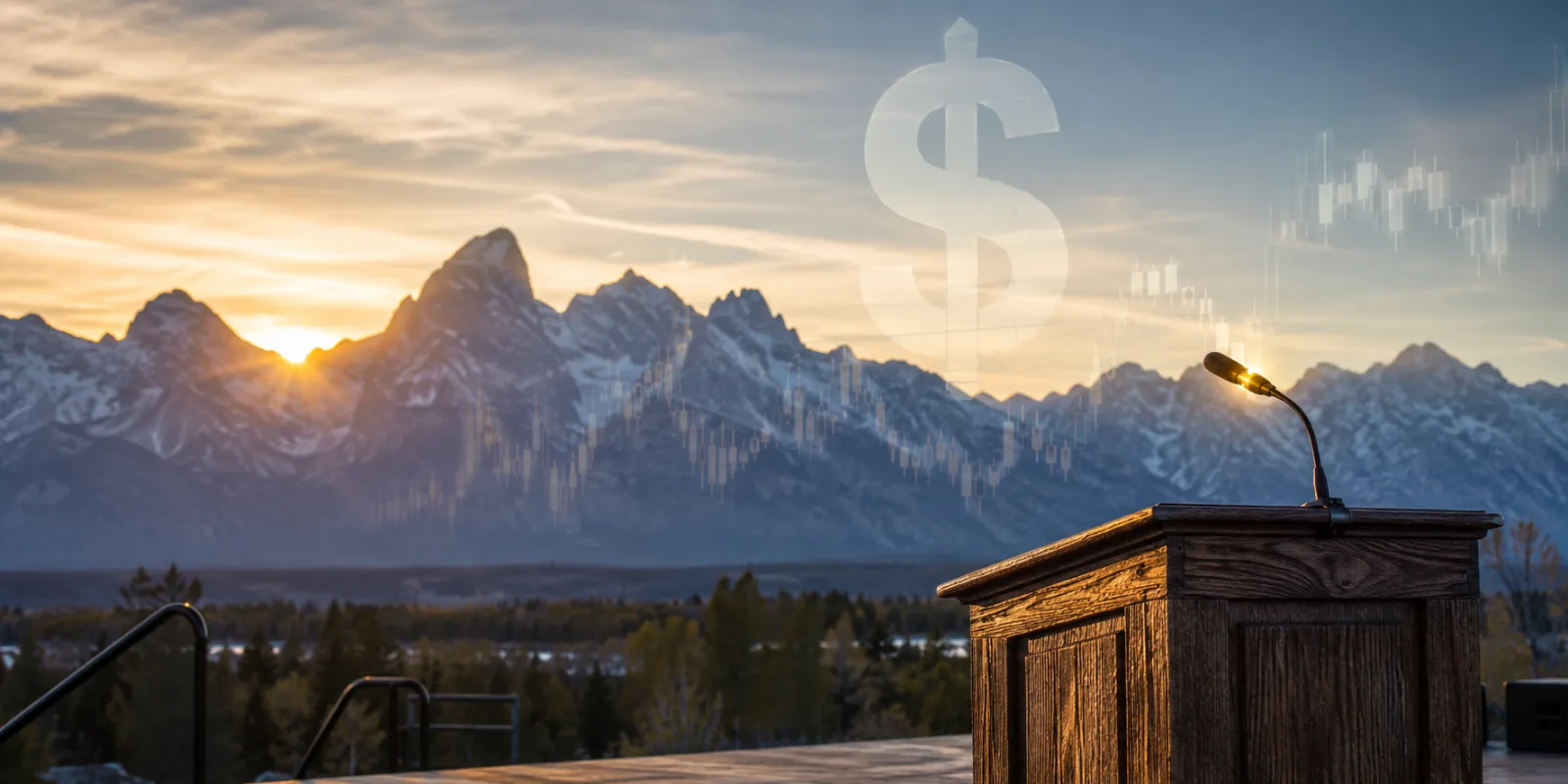
A single speech does not usually decide where the world's reserve currency trades. This Friday might be an exception. On 28 August, Kevin Warsh steps up to the lectern in the Grand Teton foothills to deliver his first keynote as Chair of the Federal Reserve. Currency desks, bond traders and crypto funds have spent the week doing the same thing: taking risk off the table and waiting to hear what kind of central banker he intends to be.
The stakes are unusually concrete. Long-dated US Treasury yields are sitting near their highest levels in two decades, the dollar has been swinging around after touching a three-month low, and Bitcoin has slipped back under $79,000. For once, foreign exchange and cryptocurrency are reading from the same script, and the script is written in Warsh's voice.
What happened#
Warsh took over the Fed in May 2026 and quickly made clear he would run it differently from his predecessor. Since taking office he has pulled back sharply on the detailed forward guidance that markets had grown used to under Jerome Powell, according to Fox Business. Investors read the silence as a lack of urgency about bringing inflation back to target, and long-term borrowing costs climbed to a two-decade high in response.
That is the backdrop to the Kansas City Fed's annual Jackson Hole Economic Policy Symposium, which runs from 27 to 29 August. Bloomberg reports that Warsh's Friday keynote is his clearest chance yet to explain how he wants the Fed to respond to inflation that has stayed above the 2% goal for longer than officials would like. The federal funds target sits at 3.50% to 3.75%, and at the last policy meeting three officials broke ranks to vote for a rate rise, per market coverage from XTB.
The market has noticed. Instead of debating how many cuts are left in 2026, traders have started to price the opposite risk. CoinDesk noted Bitcoin dropping below $79,000 this week as some traders began betting on a Fed hike rather than an easing. A hawkish surprise from a new chair with something to prove would land on a market that is not fully positioned for it.
The mechanics behind the move#
To see why one speech carries this weight, it helps to separate two things that are moving at once.
The first is the level of interest rates. When the Fed raises its policy rate, or is expected to, the return on safe dollar assets such as short-dated Treasury bills goes up. Higher risk-free returns tend to pull capital towards the dollar and away from assets that pay no yield, which includes both foreign currencies with lower rates and cryptocurrencies. This is the interest rate differential that drives much of the currency market. A wider gap in the dollar's favour usually means a stronger dollar.
The second is the shape of the yield curve, meaning the difference between short-dated and long-dated bond yields. Right now the long end is doing something notable. As of 27 August the 2-year Treasury note yielded about 4.211%, the 10-year about 4.645%, and the 30-year about 5.161%, according to FXStreet. Long yields near multi-decade highs, even as the Fed holds its policy rate steady, tell you that investors are demanding more compensation to lend to the government for thirty years. That extra compensation is the term premium, and it rises when investors are unsure about future inflation and about who is minding it.
Warsh can move both levers with words alone. If he signals that he will tolerate above-target inflation to protect growth, short-term rate expectations fall but long yields can rise further as investors lose confidence in the inflation anchor. If he signals a genuine hardening, a "regime change" of the sort he has hinted at, short-term rate expectations jump and the whole curve reprices. Either way, the dollar and Bitcoin sit directly downstream.
What it means across markets#
The clearest transmission is into foreign exchange. The US Dollar Index, which measures the currency against a basket of six major peers, fell to around 98.5 on 22 August, its weakest since May, after a Treasury buyback and a 9-3 split on the policy committee knocked confidence, per Vantage Markets. Heading into the keynote the index has steadied. The euro is holding near 1.1650 and the dollar is above 159.00 against the yen, according to FXStreet's daily wrap. A hawkish Warsh would likely push the dollar up and drag the euro and the pound down; a dovish or vague message would do the reverse.
Fixed income is the second channel, and it may be the loudest. Bond yields eased slightly on 27 August as traders squared positions before the speech, CNBC reported, but the direction of the long end from here depends on whether Warsh restores the market's faith in the inflation target. Rising long yields also feed straight back into equities, mortgages and corporate borrowing, which is why a currency and crypto story is really a whole-market story.
Crypto is the third channel, and the most sensitive to liquidity. The total cryptocurrency market stood near $2.76 trillion this week, with Bitcoin dominance around 57%, per crypto market data. US spot Bitcoin exchange-traded funds recorded about $389.7 million of net outflows between 10 and 14 August, their largest weekly withdrawal in six weeks, according to KuCoin citing SoSoValue data. XRP has slipped below the $1.00 mark. When the dollar strengthens and real yields rise, the opportunity cost of holding an asset that generates no cash flow goes up, and speculative money tends to retreat first from the smaller tokens.
Market snapshot ahead of the keynote#
| Instrument | Level (around 27 Aug 2026) | Why it matters | Source |
|---|---|---|---|
| US Dollar Index (DXY) | ~98.5 | Weakest since May; the single cleanest read on the speech | Vantage |
| EUR/USD | ~1.1650 | Largest DXY component; hawkish Warsh pressures it | FXStreet |
| USD/JPY | ~159.00 | Sensitive to the US-Japan yield gap | FXStreet |
| 10-year Treasury yield | ~4.645% | Global benchmark for risk assets | FXStreet |
| 30-year Treasury yield | ~5.161% | Near a two-decade high; term-premium signal | FXStreet |
| Bitcoin (BTC) | ~$78,800 | Slipped below $79,000 on Fed-hike bets | CoinDesk |
| Fed funds target | 3.50%-3.75% | Three officials dissented for a hike | XTB |
Reading a central banker in real time#
Traders will not get a policy decision on Friday. They will get language, and they will price it in seconds. Two tools do most of the work here.
The first is the rate expectations curve implied by interest rate futures. Contracts such as CME's fed funds and SOFR futures let the market bet on where the policy rate will sit at each future meeting. The CME FedWatch tool converts those prices into probabilities. This week the readings have been unstable, with money markets flickering between pricing a hold and pricing at least one more increase before the year is out, which is exactly why Warsh's tone matters so much. The important point for readers is that these are market-implied probabilities, not forecasts of what will happen. They move the instant new information arrives.
The second is the reaction function that desks build for the speech itself. Analysts map specific phrases to expected moves. A firm reference to restoring the 2% target reads as hawkish and would be expected to lift the 2-year yield and the dollar together. Any softening on the inflation timeline reads as dovish and would be expected to pull them down. FX desks flag that the dollar index can travel 0.5% to 1.5% in the hours after a keynote of this kind, per Vantage's preview. For Bitcoin, which trades continuously and carries more leverage, the initial swing is often larger and faster, then partly reverses as spot buyers step in.
The case for caution#
There are good reasons not to treat Friday as a foregone conclusion. A fund-manager survey cited by Bloomberg found that roughly two-thirds of respondents expect Warsh to strike a neutral tone, neither hawkish nor dovish. A new chair at his first Jackson Hole has an incentive to sound measured rather than to rattle a fragile bond market on day one.
The bigger risk is over-reading a single speech. Jackson Hole keynotes are set-piece events written for effect, and the immediate market reaction is frequently faded within days once the actual data resumes. There is also a genuine tension in Warsh's position that words cannot resolve. If he talks tough on inflation but the economy is slowing, he risks tightening into weakness. If he stays quiet to avoid that, long yields may keep climbing on their own and do the tightening for him, which some strategists argue is already happening. Crypto adds its own wrinkle: the correlation between Bitcoin and the dollar is real but not stable, and structural flows through the spot ETFs can override the macro signal for stretches at a time, as the recent mix of outflows and later inflows shows.
None of this is investment advice, and the probabilities above are estimates that can change with a single data release. The honest summary is that the range of outcomes on Friday is wider than usual, and the market knows it.
Is this a turning point or just noise#
Set against past Augusts, this one looks structurally different. Powell's 2022 Jackson Hole speech was read as hawkish and knocked more than 3% off the S&P 500 in a session. In 2025 a dovish Powell sent yields and the dollar lower and equities higher, per Fox Business. Those were speeches by a known quantity adjusting a known framework.
What is new in 2026 is that the framework itself is in question. Markets are not just guessing at the next move; they are trying to work out the rules of a fresh regime under a chair who has openly floated changing them. That is closer to a structural shift in how the Fed communicates than to the usual cyclical guessing game. Whether it becomes a lasting change depends entirely on whether Warsh follows Friday's words with consistent action over the coming meetings. A single hawkish speech is a headline. A durable change in the inflation anchor is a different thing, and it would reprice the dollar and every risk asset for longer than a trading week.
Key takeaways#
- Kevin Warsh gives his first Jackson Hole keynote as Fed Chair on Friday 28 August, and it is the most consequential currency and crypto event of the week.
- Long-dated Treasury yields near two-decade highs signal that investors doubt the inflation outlook, which raises the stakes for what Warsh says.
- A hawkish tone would likely lift the dollar and pressure the euro, the yen and Bitcoin; a dovish or vague tone would do the reverse.
- Crypto is the most liquidity-sensitive channel, with Bitcoin already below $79,000 and spot ETF flows swinging both ways.
- Most fund managers expect a neutral message, and initial reactions to Jackson Hole speeches often fade, so the durable signal is in the follow-through, not the headline.
Frequently asked questions#
What is the Jackson Hole symposium? It is an annual conference hosted by the Federal Reserve Bank of Kansas City in Wyoming, where central bankers, academics and policymakers discuss economic policy. The Fed Chair's keynote often signals shifts in thinking, which is why markets watch it closely.
Why does one speech move currencies so much? Exchange rates are driven largely by expected interest rate differences between countries. A speech that changes the expected path of US rates changes the relative appeal of holding dollars, and traders reprice instantly.
Who is Kevin Warsh? He is the current Chair of the Federal Reserve, in office since May 2026. A former Fed governor, he has signalled a tougher stance on inflation and has reduced the detailed guidance the Fed offered under Jerome Powell, per Bloomberg.
Why is Bitcoin falling when the dollar is only moderately strong? Bitcoin pays no yield, so when safe dollar assets offer higher real returns, some investors rotate out of it. Leverage and ETF flows can amplify the move, and smaller tokens such as XRP tend to fall first.
Could the dollar weaken even if Warsh sounds hawkish? Yes. If the market has already priced in a tough message, the dollar can fall on "sell the fact" once the speech confirms expectations. Positioning matters as much as the content.
Is a Fed rate hike in 2026 now likely? Markets are pricing a meaningful and shifting probability of at least one more increase before year-end, but this is a market-implied estimate, not a decision. It can move sharply on new data.
What should I watch in the minutes after the speech? The 2-year Treasury yield and the dollar index give the fastest clean read on how hawkish the market judged the message, followed by Bitcoin for the leveraged risk reaction.
Glossary#
US Dollar Index (DXY): A measure of the dollar's value against a basket of six major currencies, weighted heavily towards the euro.
Interest rate differential: The gap between interest rates in two economies. A wider gap in a currency's favour tends to strengthen it.
Term premium: The extra yield investors demand for holding a long-dated bond rather than rolling over short-dated ones, reflecting uncertainty about future inflation and rates.
Forward guidance: Communication by a central bank about the likely future path of policy, used to shape market expectations without changing rates immediately.
CME FedWatch tool: A tool that converts prices of fed funds futures into implied probabilities for future Fed rate decisions.
Spot Bitcoin ETF: An exchange-traded fund that holds Bitcoin directly, letting investors gain exposure through a regulated brokerage account. Its daily inflows and outflows are a gauge of institutional demand.
Hawkish and dovish: Hawkish describes a preference for higher rates to fight inflation; dovish describes a preference for lower rates to support growth.
References#
- Bloomberg, "Kevin Warsh to Make First Jackson Hole Speech as Fed Chair," 22 August 2026. https://www.bloomberg.com/news/articles/2026-08-22/kevin-warsh-to-make-first-jackson-hole-speech-as-fed-chair
- Fox Business, "Federal Reserve's Warsh faces inflation pressure ahead of Jackson Hole." https://www.foxbusiness.com/economy/fed-chair-warsh-faces-jackson-hole-spotlight-inflation-rate-path-focus
- CNBC, "Treasury yields ease ahead of jobs data and Jackson Hole," 27 August 2026. https://www.cnbc.com/2026/08/27/us-bonds-us10y-jackson-hold.html
- FXStreet, "Why this could be the most important Jackson Hole in years," 27 August 2026. https://www.fxstreet.com/analysis/why-this-could-be-the-most-important-jackson-hole-in-years-202608271229
- FXStreet, "Forex Today: Markets quiet down ahead of Jackson Hole Symposium," 27 August 2026. https://www.fxstreet.com/news/forex-today-markets-quiet-down-ahead-of-jackson-hole-symposium-202608270730
- Vantage Markets, "US Dollar Index (DXY) Falls to 98.55," 24-28 August 2026. https://www.vantagemarkets.com/market-analysis/us-dollar-index-dxy-falls-98-55-jackson-hole-august-24-28-2026/
- CoinDesk / CoinSpectator, "Bitcoin below $79,000, XRP leads losses as traders start betting on a Fed hike," 27 August 2026. https://coinspectator.com/other/2026/08/27/bitcoin-below-79000-xrp-leads-losses-as-traders-start-betting-on-a-fed-hike/
- KuCoin, "Bitcoin ETFs Experience $390 Million Outflow Despite Cooling Inflation." https://www.kucoin.com/news/flash/bitcoin-etfs-see-390m-outflow-in-week-despite-cooling-inflation
- XTB, "Jackson Hole 2026: Warsh's First Fed Speech and Market Impact Guide." https://www.xtb.com/en/education/jackson-hole-2026-warsh-fed-speech
- Federal Reserve Bank of Kansas City, "Jackson Hole Economic Policy Symposium." https://www.kansascityfed.org/research/jackson-hole-economic-symposium/
- Coin Gabbar, "Crypto News Today 27 August," 27 August 2026. https://www.coingabbar.com/en/crypto-currency-news/crypto-news-today-27-august-bitcoin-eth-bitlayer-crypto-tax
This article is for information only. It is not investment advice, and it does not recommend buying or selling any asset. Market levels and probabilities are estimates as of 27 August 2026 and can change quickly.