The Quant Crowd Ran for One Exit: Anatomy of the 2026 Systematic Unwind
In July 2026 the crowded AI-momentum trade reversed and systematic hedge funds suffered their sharpest drawdown in a year. Here is what happened, why the models moved together, and what it means for markets.

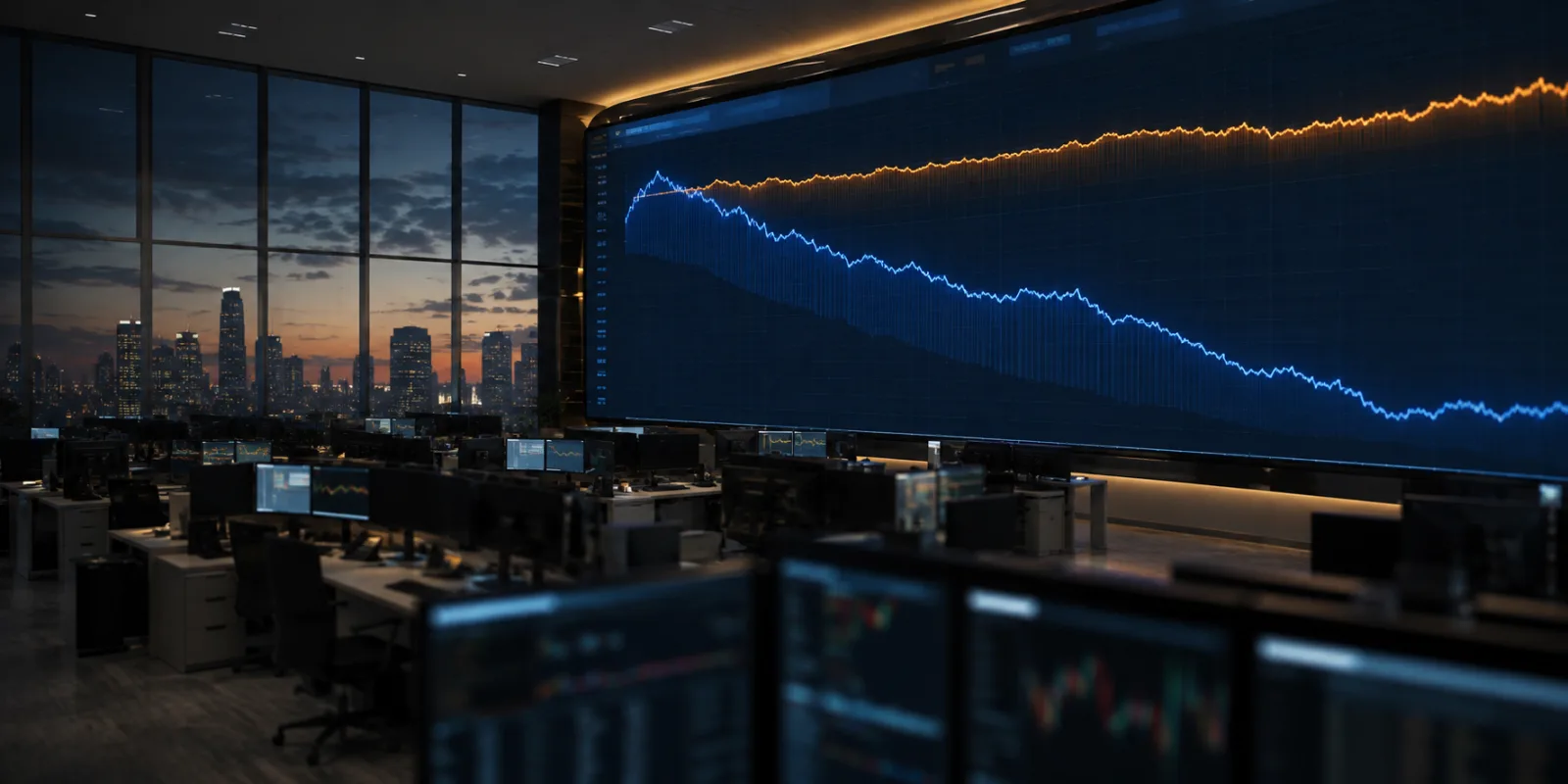
For most of 2026, the machines were winning. Systematic hedge funds, the computer-driven strategies that trade on statistical signals rather than a manager's hunch, were up 14.4% by 22 June, riding the same artificial-intelligence and momentum wave that had lifted semiconductors and the rest of the technology complex. Then the wave broke. Over the following weeks, those funds handed back roughly a quarter of their gains, and by the time Hedge Fund Research (HFR) published its July numbers in the second week of August, technology-focused hedge funds had recorded their worst month since the depths of the 2008 crisis. This is not a story about one bad bet. It is a story about a lot of people making the same bet, and then trying to leave through the same door at the same time.
The clearest picture comes from Goldman Sachs' prime brokerage desk, which sees the aggregated positioning and flows of a large slice of the hedge fund industry. According to a Goldman client note reported by Reuters and Investing.com, the AI and momentum trade that dominated the first half of 2026 reversed sharply from 22 June. Systematic managers took the brunt of it, falling 3.6% in what Goldman called their worst drawdown since the summer of 2025. That knocked their year-to-date return down to 10.8% from 14.4%. Crucially, Goldman said the damage was concentrated on the short side, led by US equities and followed by developed Asia and Europe, with momentum and crowded positioning the main culprits.
Fundamental stock-pickers held up better in absolute terms, slipping 2.2% while remaining up 15.5% for the year. However, only 0.8 points of that loss were due to genuine stock selection. The rest stemmed from their technology and momentum exposure. Those managers responded by aggressively cutting the AI longs that had generated their entire year-to-date alpha, stripping momentum from their books and pushing gross leverage into the bottom decile over the past year.
The monthly data confirmed the severity. HFR's index of technology-focused hedge funds fell 7.0% in July, its worst showing since January 2008, dragging the broad HFRI Fund Weighted Composite to a 1.1% loss, its first down month since March. Systematic diversified and CTA strategies fell 0.9%. The dispersion was startling: the top tenth of funds gained an average of 7.6% in July while the bottom tenth lost 12.5%, and only about 45% of hedge funds finished the month in positive territory.
What a systematic strategy is actually doing#
To see why so many funds moved together, it helps to know what these strategies are and are not. A systematic or quantitative strategy uses a rules-based model to decide what to buy and sell. Instead of an analyst forming a view on a company, a computer ranks thousands of securities by measurable characteristics, called factors, and takes long positions in the attractive ones and short positions in the unattractive ones.
The workhorse factors are well known. Momentum buys recent winners and shorts recent losers on the empirical observation that trends persist over medium horizons. Value tilts toward cheap stocks. Quality favours profitable, stable companies. Low-volatility prefers calmer names. These are not proprietary secrets; they are documented in decades of academic research and packaged into thousands of funds. That ubiquity is the point, and the problem.
Two mechanical features matter for what followed. First, most of these books are built to be market-neutral, meaning the long and short sides are roughly balanced so the fund is not simply betting on the market going up. The return is supposed to come from the spread between the longs and the shorts. Second, to turn a small, reliable spread into an interesting return, funds apply leverage, borrowing to hold positions several times larger than their capital. Leverage magnifies the spread. It also magnifies the pain when the spread moves the wrong way.
How a factor reversal becomes a fire sale#
The mechanism that turned an ordinary drawdown into a synchronised unwind is factor crowding. When a factor such as AI-driven momentum works, capital piles in. Many funds end up holding similar longs and similar shorts because they are fishing in the same signal pond. On the way up, this is invisible and pleasant. On the way down, it is neither.
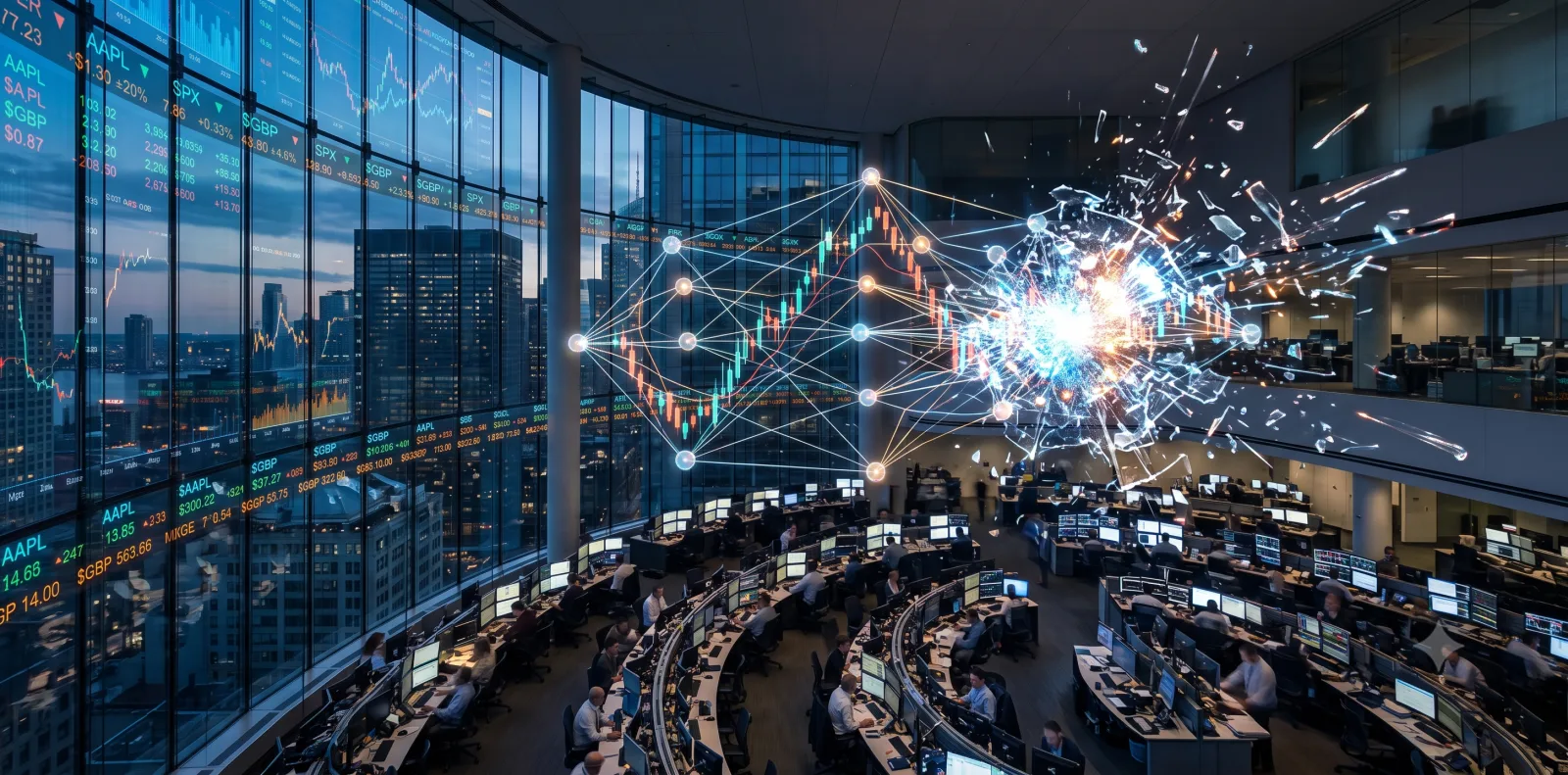
The sequence runs roughly like this. A trigger, in this case a rotation out of AI and semiconductor stocks from late June, pushes the crowded longs down and the crowded shorts up, exactly the opposite of what the models expect. Because positions are leveraged, losses eat into capital quickly. Risk systems, many of which target a fixed level of volatility or value-at-risk, then instruct funds to cut exposure to bring risk back in line. When a fund reduces a leveraged market-neutral book, it sells its longs and buys back its shorts. If hundreds of funds hold the same longs and shorts and all de-risk at once, their selling pushes the longs down further and their short-covering pushes the shorts up further. That deepens everyone's losses and triggers the next round of forced selling. The feedback loop is why Goldman could see the pain concentrated so precisely on the short side.
Liquidity decides how violent this gets. The reversal hit hardest where positioning was most crowded and where the underlying stocks were harder to trade. In China, Zhejiang High-Flyer Asset Managementrun by Liang Wenfeng and managing more than RMB70bn (about $10bn), saw one fund drop 15.7% in the week to 17 July. It had been positioned to beat the CSI 1000 index of smaller companies, which trade less actively than large caps, so the exit was disorderly. Separately, Bloomberg reported that a fund linked to Jupiter Research Capital and Shanghai Minghong plunged more than 40% in around three weeks. Elevated retail leverage in markets such as South Korea amplified the swings further.
The reach extended beyond equity long-short desks. Because the AI trade had become a macro theme, its reversal touched index futures, single-stock options, and the funding markets that support leverage. It also fed a broader risk reduction: as fundamental managers cut AI longs, industry leverage dropped to its lowest level in a year, a signal that will ripple into everything from prime broker balance sheets to the depth of the order book.
Crowding, VaR targeting and the reflexive loop#
The uncomfortable truth for quantitative investing is that a strategy's popularity erodes its own edge and raises its fragility. Two ideas make this concrete.
The first is the volatility, or value-at-risk (VaR) target. Value-at-risk is a statistical estimate of how much a portfolio might lose over a given period with a given probability, say a 5% chance of losing more than a certain amount in a day. Many systematic funds size their positions so that estimated risk stays near a constant target. This sounds prudent, and in isolation it is. But it makes selling procyclical. When volatility spikes, the models automatically shed exposure, and if enough funds run similar risk models, they sell in unison, pushing volatility higher still and forcing more selling. The risk control becomes a transmission mechanism.
The second is reflexivity in crowded factors. A factor's historical Sharpe ratio, the ratio of its excess return to its volatility, is estimated on data from a period when few people traded it. As assets chase the same signal, the realised return falls and the correlation of that book with everyone else's rises. The factor's true risk is no longer just its own volatility; it is its exposure to a sudden, collective deleveraging that does not appear in the backtest. This is precisely the trap that quant lore warns about, where a model identifies a pattern that is statistically real but economically fragile once it is crowded.
None of this means the models are broken. It means their risk is state-dependent. A momentum book that behaves impeccably in a calm, trending market can become a different, far more dangerous instrument in a fast reversal, because its hidden exposure to the crowd only shows up when the crowd moves.
What to make of it#
The strengths of systematic investing are real and worth stating plainly. The approach is disciplined, testable and free of many behavioural biases that trip up discretionary traders. Over five years, quant strategies have been among the best-performing hedge fund categories, which is why they still drew the bulk of industry inflows into 2025. A single bad month does not overturn that record.
The limitations are equally real. Crowding is hard to measure from the inside, because a fund can see its own positions but not the market's aggregate book. Firms increasingly buy prime broker crowding data and build proxies from public filings and short interest, but these are lagged and incomplete. Risk models built on historical volatility systematically understate the danger of correlated deleveraging, which by definition is rare in the sample. And leverage, the tool that makes thin spreads profitable, is also what converts a manageable drawdown into a forced one.
There is a competing view worth airing. Some argue that these unwinds are healthy and self-correcting: crowded positions get flushed, valuations reset, and disciplined managers who kept leverage modest can add exposure at better prices. On this reading, July was a cleansing rather than a warning. The counterargument, favoured by regulators, is that each episode is more violent than the last because leverage and concentration keep rising. The Federal Reserve's May 2026 Financial Stability Report and its work decomposing hedge fund Treasury exposures both flag how concentrated leveraged positions can strain market liquidity under stress, and the Bank of England, the Bank of Japan and the Bank for International Settlements have made similar warnings about crowded positioning amplifying shocks. The honest position is that both things can be true at once: the July unwind was orderly enough to absorb, and the structural fragility that produced it has not gone away.
The ghost of August 2007#
Anyone who has worked in quant equities felt a shiver of recognition in July. In August 2007, a very similar sequence was later dissected by Amir Khandani and Andrew Lo in their study of the "quant quake"saw market-neutral statistical arbitrage funds suffer sudden, severe losses over a few days as one large book was apparently liquidated, forcing others with similar positions to deleverage into each other. The market-level moves were small; the factor-level moves were enormous, because the pain was concentrated in exactly the long-short spreads that quants shared.
Is 2026 a repeat, a cycle or something new? It is best read as the same structural pattern expressed through a new theme. In 2007, the crowded factors were classical value and mean-reversion signals. In 2026, the crowd gathered around an AI-and-momentum trade that had become the dominant story in global equities. The plumbing, correlated positioning and leverage plus procyclical risk models, is unchanged. What has changed is scale. Industry leverage and the concentration of positions have grown over the intervening two decades, which is the core of regulators' concerns. So this is not a paradigm shift in how markets work. It is a recurring structural feature that grows slightly larger each cycle.
For now the acute phase looks to have passed. By mid-August, prime broker data showed hedge funds cautiously returning to equities as risk appetite recovered, and some were already rotating from AI infrastructure names toward companies seen as monetising the technology. The trade is being rebuilt, probably with a different roster of favourite stocks. Whether the crowd learns to size it more carefully this time is the open question.
Key takeaways#
The July 2026 selloff was a factor unwind, not a market crash. Broad indices moved modestly while crowded long-short spreads moved violently, which is why market-neutral systematic funds were hit hardest.
Goldman's data quantifies it: systematic managers fell 3.6% from 22 June and gave back about a quarter of their year's gains, landing at 10.8% year-to-date.
HFR pegs July as the worst month for technology hedge funds since January 2008, with wide dispersion and fewer than half of all funds positive.
The engine was crowding plus leverage plus procyclical risk targeting, the same mechanism as the 2007 quant quake, now operating at larger scale.
Regulators including the Federal Reserve, the Bank of England and the BIS have flagged that rising leverage and concentration make each of these episodes potentially more forceful.
Frequently asked questions#
What is factor crowding? It is when many funds hold similar long and short positions because they use similar signals. The positions look uncorrelated on paper but become highly correlated during a sell-off, when everyone tries to reduce risk at once.
Why did market-neutral funds lose money if they were hedged? They are hedged against the overall market direction, not against a reversal in the specific factors they trade. When their crowded longs fell, and their crowded shorts rose together, the spread they were betting on moved against them.
What is value-at-risk targeting and why does it matter here? Value-at-risk estimates the potential loss over a period at a specified probability level. Funds that hold risk near a fixed level automatically sell when volatility rises. If many funds do this together, their selling raises volatility further and forces more selling, a self-reinforcing loop.
Is this the same as the August 2007 quant quake? It rhymes with it. Both involved leveraged, market-neutral quant books deleveraging into one another. The mechanism is the same; the theme, an AI and momentum trade, is new, and the scale of leverage is larger.
Did quant trading fail? No. These strategies remain among the strongest multi-year performers in the hedge fund industry. July exposed a known vulnerability rather than a flaw in the basic approach.
How can a fund reduce the risk of crowding? Options include diversifying across less popular signals, capping leverage, buying prime broker crowding analytics, stress-testing for correlated deleveraging rather than only historical volatility, and holding liquidity buffers so it is not forced to sell into a falling market.
Is the danger over? The acute drawdown appears to have passed, and funds are re-risking, but the structural drivers, high leverage and concentrated positioning, remain, so similar episodes are likely in future.
Should ordinary investors do anything? This article is analysis, not advice. The main lesson for any investor is a general one about concentration: when a single theme dominates a portfolio or a market, the exit can be crowded, and diversification is the standard defence.
References#
- Investing.com / Reuters, via Yahoo Finance, "Goldman says AI trade reversal pressures hedge fund returns", 9 July 2026.
- Hedgeweek, "AI-led market reversal hits quant hedge funds as crowded trades unravel", 10 July 2026.
- Hedgeweek, "China quant hedge funds hit by AI-led selloff as systematic strategies suffer sharp losses", 21 July 2026.
- Bloomberg, "Jupiter Quant Fund Shanghai Minghong Plunged More Than 40%", 31 July 2026.
- Hedgeweek, "AI rout sees tech hedge funds record worst monthly performance since 2008" (HFR data), 10 August 2026.
- Hedgeweek, "Hedge funds return to equities as risk appetite rebounds", 11 August 2026.
- Hedgeweek, "Hedge funds shift from AI infrastructure to monetisation plays, says Hazeltree", 13 August 2026.
- Board of Governors of the Federal Reserve System, "Decomposing Hedge Funds' U.S. Treasury Exposures", FEDS Notes, 22 June 2026.
- Board of Governors of the Federal Reserve System, "Financial Stability Report, Leverage in the Financial Sector", May 2026.
- A. Khandani and A. W. Lo, "What Happened to the Quants in August 2007?" (analysis of the 2007 quant quake).
This article is for information and analysis only. It is not investment advice, a recommendation, or an offer to buy or sell any security. Figures cited are drawn from the sources listed and reflect estimates and interpretations available at the time of writing. Performance figures are historical and are not a guide to future returns.