Warsh's Jackson Hole Shock: Why Markets Now Fear a 2026 Rate Hike
Fed Chair Kevin Warsh used his Jackson Hole debut to bury forward guidance and warn on inflation. Markets repriced a September hike from a third to a coin-flip. Here is what changed and why it matters.

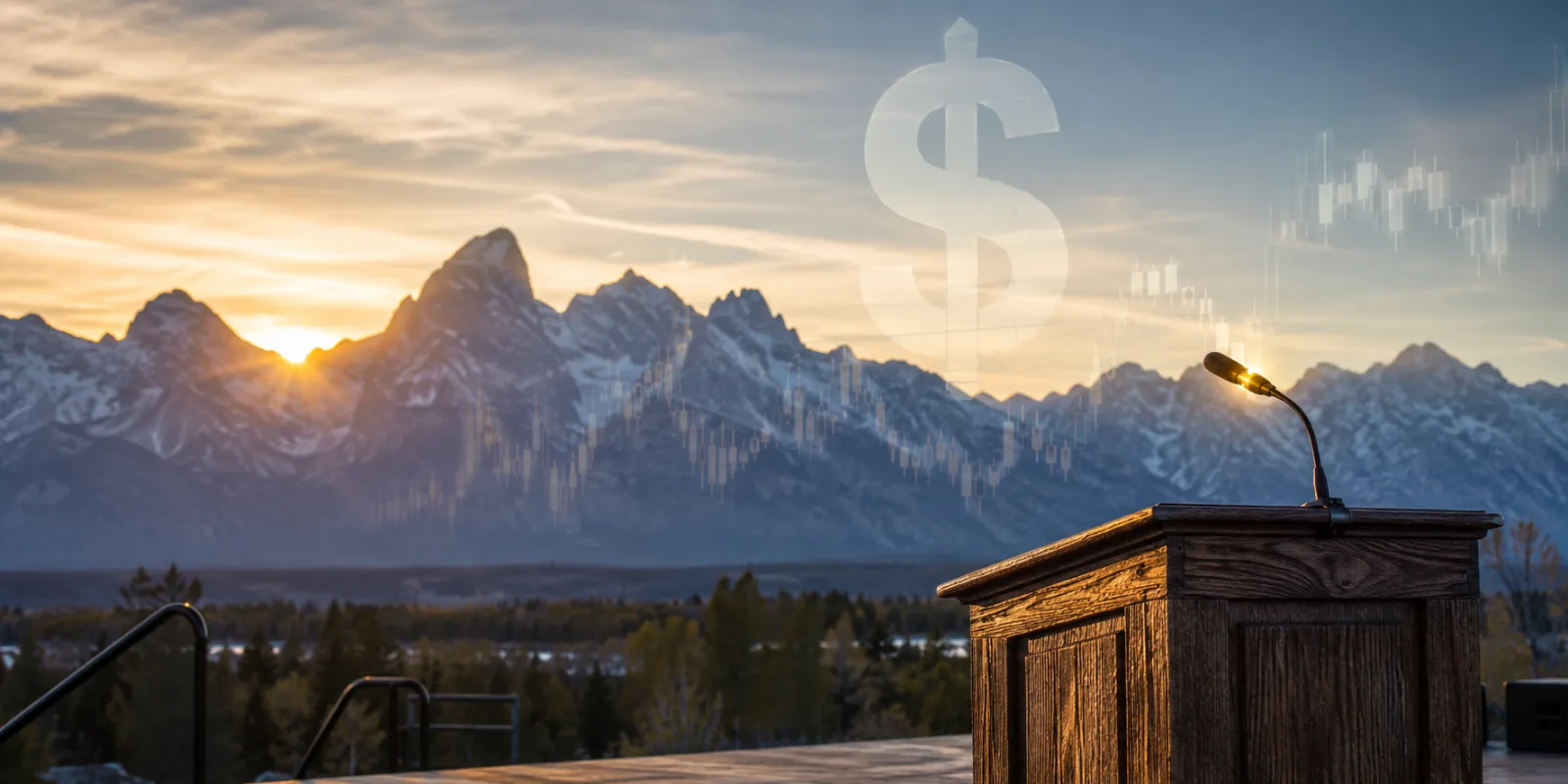
Central bankers usually go to Jackson Hole to reassure. On 28 August, in his first keynote as Federal Reserve Chair, Kevin Warsh did the opposite. He told the assembled economists that inflation is not beating, that the Fed still has "work to do", and, almost in the same breath, that he intends to stop telling markets what the Fed will do next. Traders reacted before the applause faded. The probability of a September rate rise, priced from interest-rate futures, roughly doubled from about a third to a coin flip within hours. For a market that spent two years positioning for cuts, the direction of travel had reversed.
What actually happened at Jackson Hole#
Warsh, on his 100th day in the job, used the Kansas City Fed's annual symposium to sharpen a message that his muddled July press conference had blurred. His central claim was blunt: the Fed's preferred inflation gauge, the personal consumption expenditures (PCE) price index, was running at 3.7% over twelve months and 4.1% on a six-month annualised basis, well above the 2% target he called "a firm, fixed target". His standard for easing was equally plain: the Fed must be "confident that underlying inflation is moving to our objective, clearly and at sufficient speed", or "we have work to do".
He paired that with a structural change to how the Fed communicates. Warsh argued that formal forward guidance (the practice of pre-committing to a rate path) "has overstayed its welcome" and risks "creating ambiguity in the name of clarity". He declined to publish an explicit reaction function or lean on a mechanical rule such as a Taylor rule, insisting he is "committed to a discipline, not to a decision".
The market read this as hawkish on two counts: a higher bar for cuts, and less hand-holding on the way there. The two-year Treasury yield, the maturity most sensitive to policy expectations, jumped more than 12 basis points to 4.356%, while the ten-year rose past 4.72% and the dollar index firmed 0.4% to 99.55. Futures tracked by CME FedWatch moved the odds of a 25 basis-point September rise to roughly a coin flip, from about one-third beforehand.
The plumbing: how a speech moves the whole curve#
To see why words shifted trillions in notional value, it helps to unpack three mechanisms.
Market-implied probabilities. Fed funds futures settle against the average daily effective federal funds rate for the contract month. Because that rate tracks the Fed's target range closely, the futures price encodes the market's expected policy path. Analysts convert the price into an implied probability of a hike or cut, the number CME FedWatch publishes. When Warsh spoke, the September contract repriced, lifting the implied hike probability from roughly 35% to near 57%.
The reaction function. Economists model the central bank as following a rule that maps the state of the economy to a policy rate. The best-known example is the Taylor rule, which sets rates higher when inflation exceeds target and lower when output falls below potential. Warsh's refusal to commit to such a rule matters because it widens the range of plausible outcomes: with less guidance, each data release carries more weight, and markets must price a fatter distribution of paths. That uncertainty alone tends to push up the term premium: the extra yield investors demand for holding longer-dated bonds.
Duration and the dollar. Short-dated yields respond to expected policy; the two-year's outsized move signals a genuine shift in near-term rate bets, not just a term-premium wobble. A higher expected US rate path also raises the return on dollar assets relative to the euro, yen and sterling, which is why the dollar firmed as yields climbed.
Why this is the story that matters this week#
Several developments competed for attention as August closed, including a fresh geopolitical flare-up. Yet the repricing of the Fed's path is the one with the broadest reach, because the federal funds rate is the anchor for global borrowing costs, currency valuations and equity discount rates.
The table below summarises the immediate cross-asset reaction.
| Asset / gauge | Before speech (approx.) | After speech | Move | What it signals |
|---|---|---|---|---|
| 2-year Treasury yield | ~4.23% | 4.356% | +12 bp | Sharp repricing of near-term policy |
| 10-year Treasury yield | ~4.68% | ~4.73% | +5 bp | Higher-for-longer, modest term-premium lift |
| US Dollar Index (DXY) | ~99.15 | 99.55 | +0.4% | Rate differential favours the dollar |
| S&P 500 (Friday close) | n/a | -0.3% | lower | Higher discount rate weighs on equities |
| Sept hike probability (FedWatch) | ~35% | ~57% | ≈ +22 pts | Coin-flip on a September rise |
| Brent crude (Sun 30 Aug) | mid-$80s | above $90 | ~+2% | Oil shock revives the inflation risk |
Sources: Federal Reserve, CNBC, GV Wire, CNBC markets. Pre-speech levels are approximate, derived from reported moves.
The oil move is the amplifier. On 30 August, Brent pushed above $90 a barrel after a US strike near the Strait of Hormuz, the chokepoint for roughly a fifth of seaborne crude. Warsh had already flagged that "the recent rise in overall commodity prices … bears watching". A supply-driven energy spike feeds directly into headline inflation and, if sustained, into expectations, the very channel he warned must stay anchored.
The wider market implications#
For fixed income, the message is higher-for-longer with fatter tails. A flatter or inverted front end can persist if the market prices even a small chance of hikes; investors holding long duration face mark-to-market risk if the term premium keeps rising.
For equities, the discount-rate channel bites. A higher risk-free rate lowers the present value of future cash flows, which weighs hardest on long-duration growth stocks. There is an irony here, because Warsh spent much of his speech marvelling at the artificial-intelligence capital boom, which he said accounts for more than half of this year's rise in business investment. He also noted S&P 500 profits have grown more than 20% over the past year, so earnings strength is cushioning the blow for now.
For foreign exchange and emerging markets, a firmer dollar and higher US yields tighten global financial conditions. Currencies and dollar-borrowers outside the US feel the squeeze first; capital tends to rotate back toward dollar assets.
For quantitative and systematic strategies, the regime shift is the point. Trend-followers and rates-vol desks thrive on repricings like this, but a less predictable Fed raises realised volatility and can whipsaw carry and momentum positioning built on a stable, guided path.
The Warsh doctrine: independence, or its opposite#
Warsh's communications overhaul rests on a genuine intellectual case. He invoked the "hall-of-mirrors" problem, drawn from the academic literature: if markets rely on Fed guidance and the Fed reads its signals back from market prices, both can be blinded to new information (Stein and Sunderam, 2018, Journal of Finance). He also cited evidence that guidance can slow the response to inflation, echoing a retrospective on the Powell era (Working Paper, not peer-reviewed).
The strengths are real: less pre-commitment gives the Fed room to act on fresh data, and a quieter Fed may reduce the market's habit of "looking primarily to the Fed for their next trade", in Warsh's words. But the limitations are just as real. Removing guidance raises uncertainty, which can lift risk premia and borrowing costs precisely when the economy is fragile. Markets may also misread an unscripted chair, producing exactly the volatility guidance was designed to dampen.
There is a political dimension too. Ahead of the speech, bond and currency markets were reported "on edge" amid Treasury interventions that piled pressure on the new chair. A Fed seen bowing to fiscal or political preferences risks its inflation-fighting credibility, the intangible asset that keeps long-term expectations anchored. Warsh's insistence that 2% is non-negotiable can be read as a pre-emptive defence of that credibility.
Is this a paradigm shift or a return to type?#
In one sense, Warsh is turning the clock back. Formal forward guidance became a fixture only during the 2008 crisis; central banks managed for decades without it. Ending it is less a leap into the unknown than a return to a pre-crisis style of deliberate opacity, associated with the Greenspan era in which Warsh once served as a governor.
In another sense, the substance is a departure. Markets have spent two years pricing an easing cycle. A chair who openly entertains hikes with unemployment at just 4.1% and growth solid is asserting that the inflation of the 2020s is not "necessarily mean-reverting" and must be actively squeezed out. Whether that proves a structural regime change or a cyclical hawkish lean depends on the next two PCE prints and the path of oil. For now, the market is treating it as the former, and repricing accordingly.
Key takeaways#
- The bar for cuts has risen. Warsh set an explicit standard (clear, sufficiently fast progress toward 2% PCE) that current data do not meet, keeping a 2026 hike live.
- Forward guidance is being retired. A less scripted Fed means each data release matters more, which mechanically raises rate volatility and term premia.
- The whole curve moved. Two-year yields jumped ~12 bp, the dollar firmed, and September hike odds roughly doubled to a coin flip.
- Oil is the amplifier. Brent above $90 after the Hormuz strike revives the headline-inflation risk Warsh explicitly flagged.
- Credibility is the subtext. Amid political pressure, insisting 2% is "firm, fixed" is a defence of the Fed's inflation-fighting reputation.
Frequently asked questions#
Did the Fed raise rates? No. This was a speech, not a policy decision. The next scheduled decision is the 15-16 September FOMC meeting; Warsh signalled willingness to hike if inflation does not improve, without committing to timing.
What is forward guidance, and why scrap it? It is the practice of signalling the likely future rate path to shape expectations. Warsh argues it can trap the Fed into stale commitments and distort markets, so he prefers to decide meeting by meeting.
Why did bond yields rise rather than fall? Yields move inversely to prices. Expecting higher policy rates, investors sold shorter-dated bonds, pushing their yields up; the two-year moved most because it is the most policy-sensitive.
What does PCE at 3.7% mean? It means the Fed's preferred price index rose 3.7% over the year, well above the 2% goal, with a faster six-month pace of 4.1%, suggesting little recent improvement.
How does this reach markets outside the US? A higher US rate path lifts the dollar and global borrowing costs, tightening conditions for foreign currencies, emerging-market debtors and rate-sensitive equities worldwide.
Is a hike now the base case? No. Futures imply roughly even odds for September. That is genuine uncertainty, not a settled call, and these are market-implied estimates rather than forecasts of certainty.
Could the oil spike change the calculus? Potentially. A sustained energy shock would lift headline inflation and could harden the hawkish case; a quick reversal would ease it.
Glossary#
- PCE price index: The personal consumption expenditures index, the Fed's preferred inflation measure, currently 3.7% year on year versus a 2% target.
- Forward guidance: Central-bank communication that signals the likely future path of interest rates to shape market and household expectations.
- Reaction function: The (often implicit) rule linking economic conditions such as inflation and unemployment to the policy rate a central bank sets.
- Taylor rule: A formula that prescribes raising rates when inflation is above target and cutting when output is below potential; a benchmark reaction function.
- Basis point (bp): One-hundredth of a percentage point; a 12 bp move equals 0.12%.
- Term premium: The extra yield investors demand to hold a long-dated bond instead of rolling short-dated ones, compensating for rate uncertainty.
- CME FedWatch: A tool that converts fed funds futures prices into implied probabilities of Fed rate moves.
- Dollar Index (DXY): A gauge of the US dollar's value against a basket of major currencies; it rises when the dollar strengthens.
References#
- Federal Reserve Board: Keynote remarks by Chairman Warsh, "In Our Time", 2026 Jackson Hole Economic Policy Symposium (primary source).
- CNBC: Kevin Warsh sharpens inflation warning at Jackson Hole, signaling possible rate hike.
- CNBC: Treasury yields spike after Warsh's Jackson Hole speech.
- GV Wire: Rate-hike expectations rise on Warsh speech at Jackson Hole.
- CNBC: Dollar and bond markets 'on edge' ahead of Jackson Hole as Bessent's intervention piles pressure on Warsh.
- CNBC: Stock market live updates, 30 August 2026 (Strait of Hormuz, oil).
- Morningstar: Warsh Sounds Hawkish, but Will There Be a September Rate Hike?.
- Washington Post: Fed chair Warsh, concerned about inflation, says bank may have 'work to do'.
- Jeremy C. Stein and Adi Sunderam (2018), "The Fed, the Bond Market, and Gradualism in Monetary Policy," Journal of Finance 73(3) (peer-reviewed).
- Christina D. Romer and David H. Romer (2026), "An Early Retrospective on Monetary Policy in the Powell Era," Hutchins Center Working Paper 108.
- Eric Engstrom (2026), "Anchored to the Dot Plot: Central Bank Projections and Interest Rate Expectations," Finance and Economics Discussion Series 2026-026.
- Federal Open Market Committee: Minutes of the meeting of 28-29 July 2026.