Palantir's 93% Surge Just Lit the Fuse on the AI-vs-Bubble Debate
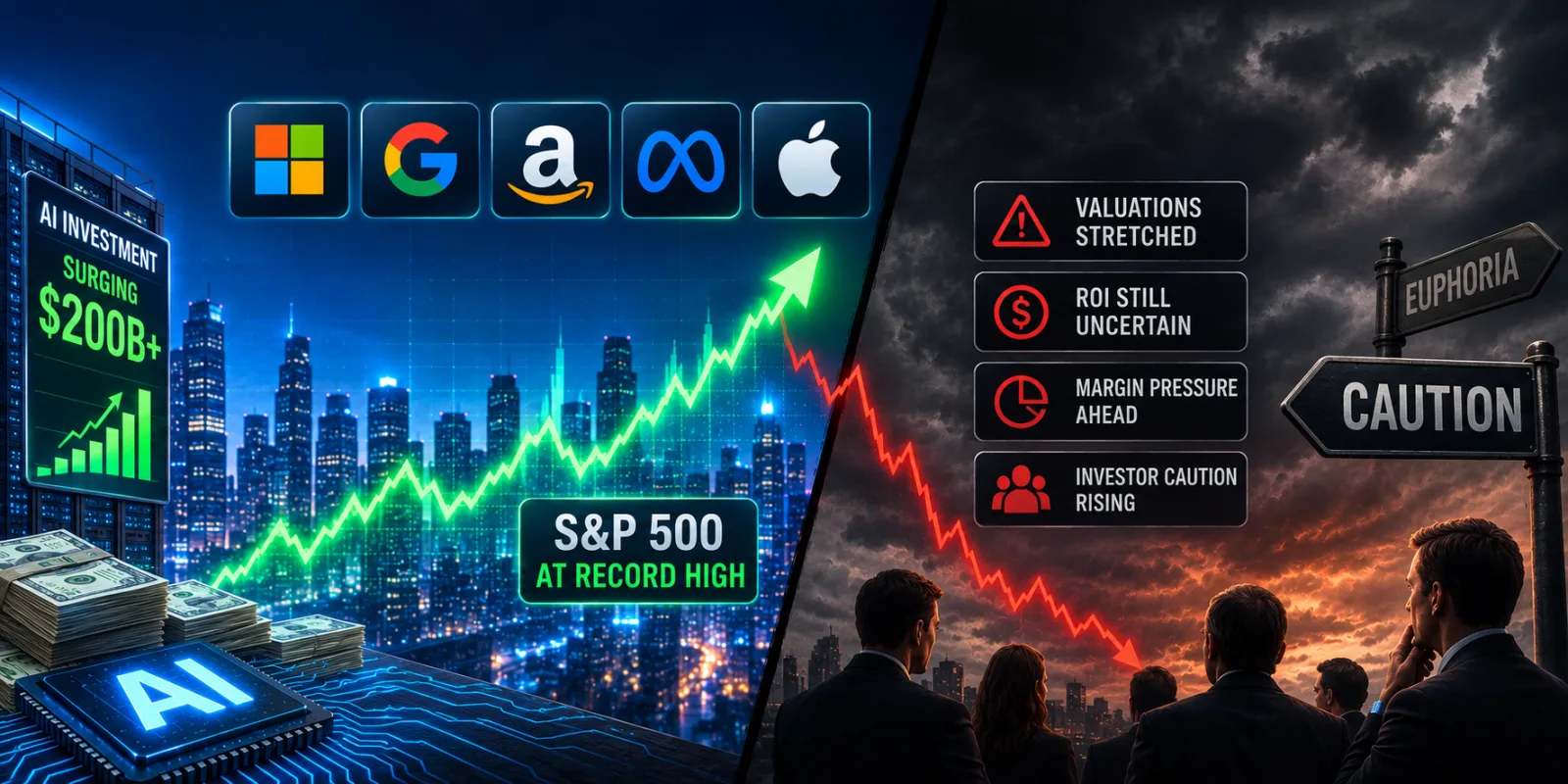
Palantir's blowout Q2 2026 earnings helped push the S&P 500 to a record close above 7,700. Here's what actually happened, why it matters for markets, and why some of the sharpest investors think the AI trade is starting to rhyme with 1999.

There are quarters where a single earnings report tells you where the whole market's head is at. Palantir's second quarter of 2026 was one of them.
After the close on August 3, the data-analytics company reported revenue growth that would look like a typo on almost any other large-cap income statement. By the time the S&P 500 rang its closing bell on August 4, it had punched through 7,700 for the first time ever, and Palantir was a big reason why. Then, before most of Wall Street had finished its morning coffee on August 5, the other side of the trade got loud: the price-to-sales math, the capital-spending arms race, and a familiar voice warning that this all looks a lot like the last months of the dot-com bubble.
So which is it: the early innings of a genuine platform shift, or the giddy top of a mania? Here's what happened, and the two stories now fighting over the same set of numbers.
What happened#
Palantir posted second-quarter revenue of $1.94 billion, comfortably ahead of the roughly $1.80 billion analysts expected, according to CNBC's earnings coverage. That was a 93% jump from a year earlier, an acceleration, not a slowdown, for a company already valued as a hyper-growth story.
The engine was the U.S. commercial business. That segment grew 149% year over year to $764 million, per the same reporting. Management noted the compounding effect: U.S. commercial revenue has climbed roughly 380% since 2024. This is the part of Palantir that sells its AI platform to ordinary American companies (insurers, manufacturers, hospitals) rather than to defence and intelligence agencies, and it has become the number the bulls point to first.
Profitability moved with it. Palantir reported net income of $1.07 billion, or 41 cents per share, versus about $329 million, or 13 cents, in the year-ago quarter, according to CNBC. The company also raised its full-year 2026 revenue guidance to a range of $8.15 billion to $8.16 billion, about 82% growth for the year, and lifted its U.S. commercial outlook above $3.42 billion, up from prior guidance of roughly $3.22 billion, as TradingKey reported. Adjusted free cash flow guidance was set at $4.50 billion to $4.70 billion.
The stock reaction was sharp. Reports of the immediate move ranged from roughly 12% to 15% higher in the sessions that followed the print (TradingKey), and Palantir was among the megacap names cited by NBC News as leading the broad advance that carried the S&P 500 to a record close of 7,736.52, up 1.79% on August 4.
Why it matters#
Earnings beats happen every day. What makes this one worth writing about is that Palantir has become a proxy for a much bigger question the whole market is trying to answer: is corporate demand for AI real enough to justify the money being thrown at it?
For most of 2026, the bull case for AI has rested on supply-side spending. The five largest U.S. hyperscalers, Microsoft, Alphabet, Meta, Amazon and Oracle, are on track to spend a combined $720 billion in capital expenditure this year, a figure that has been revised sharply higher through the year, according to reporting compiled by IndexBox and Intellectia. Amazon alone is guiding toward roughly $200 billion, Alphabet $175–185 billion, and Meta $115–135 billion.
The sceptics' retort has always been simple: that's what companies are spending, not what they're earning back. Palantir sits on the demand side of that equation. When a software firm shows 149% growth selling AI tools to regular businesses, it's evidence (imperfect, single-company evidence, but evidence) that the capex has a customer.
Market impact#
The AI trade has stopped being a sector story and become the market story. The rally that Palantir helped fuel was global: Japan's Nikkei 225 climbed 3.3%, South Korea's Kospi added 4.4%, and Taiwan's Taiex rose 3.1%, all led by AI and semiconductor names, per Rio Times' economy briefing. Nvidia, the clearest pure-play on AI infrastructure, rose 2.56% on the same wave, according to that reporting.
It matters that this is happening against a still-restrictive Federal Reserve. Philadelphia Fed President Anna Paulson said on August 4 that she believes the current target range of 3.5%–3.75% is sufficient to keep inflation drifting toward the Fed's goal, and that she was comfortable with the recent decision to hold, per CNBC and market coverage from Benzinga. In plain English: the market is setting records without help from rate cuts. Equities are being pulled up by an earnings-and-spending story, not by cheap money, which is either reassuring (the rally has real fundamentals) or worrying (there's no monetary cushion if sentiment cracks).
There's a structural wrinkle too. Microsoft, Alphabet, Amazon and Meta together carried more than $10 trillion in market value and made up around 17% of the S&P 500 earlier in 2026, per data cited by Moneywise. When a market is that concentrated, a passive index fund is a far more aggressive bet on AI than most of the people who own one realise.
Winners and losers#
Winners. Palantir's shareholders, obviously, but also the AI-infrastructure complex it validates: Nvidia and the broader semiconductor group, the hyperscalers whose spending now has a demand-side data point to cite, and the AI-native software vendors who can argue that enterprise adoption is real. Momentum and trend-following quant strategies have been on the right side of this all year, riding a single dominant factor.
Losers, or at least the exposed. Short sellers positioned against high-multiple AI names took another beating. More quietly, passive and "diversified" investors are carrying concentration risk they didn't choose: their index exposure has become a levered AI position. And any active manager who trimmed AI on valuation grounds has spent 2026 explaining underperformance to clients.
Risks and limitations#
Here's where the other August 5 story comes in, and it deserves equal weight.
Palantir is priced for something close to perfection. Even after a punishing stretch earlier in the year, its shares have traded at a forward price-to-earnings ratio above 100x and a price-to-sales ratio north of 60x, among the highest in enterprise software, per valuation analysis from Tickeron. One frequently cited figure puts the price-to-sales ratio around 65x, against a five-year average closer to 35x. As a matter of market history, companies at the frontier of a genuine technological shift have rarely sustained price-to-sales ratios above 30 for long. That doesn't make Palantir wrong; it makes it expensive, which means the growth has to keep arriving to justify the price.
Zoom out and the bear case gets its loudest voice. Michael Burry, the investor who called the 2008 housing collapse, has argued that today's tape rhymes with the final months of the 1999–2000 dot-com bubble: extreme valuations, one dominant narrative, and speculative behaviour concentrated in a few megacaps, per TheStreet and Yahoo Finance. His sharper point is a financial-engineering one: Alphabet, Amazon, Meta, Microsoft and Oracle raised more than $255 billion through debt and equity in 2026 to fund roughly $750 billion of planned AI data-centre spending, per Moneywise. When an investment boom is increasingly financed rather than self-funded, the margin for error shrinks.
The warning lights aren't only rhetorical. Bank of America's proprietary Bubble Risk Indicator has flagged the semiconductor sector near bubble territory, and the Magnificent Seven shed more than $2.2 trillion in market value during a single wobble in June 2026, per the same reporting, a reminder of how violently this trade can reverse when the mood turns. My read: Palantir's quarter is real, the demand is real, and the valuation is stretched enough that both the bulls and Burry can be right for a while before the market decides who was righter.
What investors should watch next#
A few concrete signposts, in plain terms:
Does demand keep broadening? Palantir's U.S. commercial number is the tell. If enterprise AI adoption keeps compounding across the software sector, the capex has a paying customer. If it stalls, the bear thesis gets its evidence.
Watch the hyperscalers' free cash flow, not just their capex. The question for the back half of 2026 is whether $720 billion of spending starts converting into revenue and margin, or whether it just keeps eating cash flow while the debt stack grows.
Concentration and breadth. If new highs keep coming from a shrinking group of names, that's a classic late-cycle signal. Broadening participation would be far healthier than another melt-up led by five stocks.
The Fed's next move. With the policy rate held at 3.5%–3.75%, any shift in the inflation or jobs data changes the discount rate underneath these richly valued growth stocks. High-multiple names are the most sensitive to rate expectations.
Financing conditions. Keep an eye on how much AI infrastructure is funded with fresh debt and equity. Rising leverage against speculative build-outs is exactly the fragility Burry is pointing at.
Frequently asked questions#
Why did Palantir stock jump so much? Because it beat expectations and raised guidance at a time when investors are desperate for proof that AI spending is generating real demand. Revenue grew 93% year over year to $1.94 billion, U.S. commercial revenue grew 149%, and management lifted full-year guidance to about $8.15 billion, per CNBC and TradingKey.
Is Palantir overvalued? It's undeniably expensive by traditional measures: a forward P/E above 100x and price-to-sales above 60x, well above historical norms for even great growth companies. Whether that's "overvalued" depends entirely on whether the growth persists. Expensive and doomed are not the same thing, but expensive raises the stakes on every future quarter.
What is hyperscaler capex and why does it matter? "Hyperscalers" are the giant cloud operators: Microsoft, Amazon, Alphabet, Meta and Oracle. Their capex is the money they spend building data centres, buying chips and wiring up power. In 2026 that's projected at roughly $720 billion combined. It matters because it's the clearest measure of how much the industry is betting on AI, and the biggest risk if the returns don't show up.
Is this an AI bubble? There's no consensus, and that's the honest answer. Bulls point to accelerating revenue and profits at companies like Palantir. Bears, including Michael Burry, point to extreme valuations, market concentration, and AI build-outs increasingly funded by debt, parallels to 1999. Both camps are looking at the same market and drawing opposite conclusions.
How does this affect an ordinary index-fund investor? More than you'd think. Because a few AI-linked megacaps make up such a large share of the S&P 500, owning a plain index fund is now a bigger bet on AI than it was a couple of years ago: great on the way up, painful on the way down.
This article is for information only and is not investment advice. It reflects reporting as of August 5, 2026, plus clearly labelled analysis.
Sources#
- CNBC — Palantir (PLTR) earnings Q2 2026: https://www.cnbc.com/2026/08/03/palantir-pltr-earnings-q2-2026.html
- TradingKey — Palantir surges after Q2, guidance raised to $8.15B: https://www.tradingkey.com/analysis/stocks/us-stocks/262073147-palantir-pltr-surges-q2-2026-earnings-revenue-93-percent-guidance-raised-tradingkey
- TradingKey — Palantir Q2 earnings beat estimates, stock surges: https://www.tradingkey.com/analysis/stocks/us-stocks/262072328-palantir-q2-earnings-sweep-expectations-stock-surges-15-tradingkey
- NBC News — AI stocks jump amid broadly positive outlook for 2026 markets: https://www.nbcnews.com/business/markets/ai-stocks-jump-broadly-positive-outlook-2026-markets-rcna251902
- Rio Times — Global Economy Briefing, August 5, 2026: https://www.riotimesonline.com/global-economy-briefing-august-5-2026/
- Benzinga — Will the S&P 500 open up or down August 5: https://www.benzinga.com/markets/prediction-markets/26/08/60938801/will-sp500-open-up-or-down-august-5-polymarket-record-high-ai-earnings-iran
- IndexBox — AI Infrastructure Race: $720 Billion in Hyperscaler Capex by 2026: https://www.indexbox.io/blog/ai-infrastructure-race-720-billion-in-hyperscaler-capex-by-2026/
- Intellectia — U.S. Hyperscalers Project $720 Billion Capex in 2026: https://intellectia.ai/news/etf/us-hyperscalers-project-720-billion-capex-in-2026-for-ai-infrastructure
- Tickeron — Palantir Q2 FY2026: high growth bar meets persistent valuation questions: https://tickeron.com/blogs/palantir-technologies-pltr-q2-fy2026-earnings-high-growth-bar-meets-persistent-valuation-questions-15225/
- TheStreet — Michael Burry issues blunt warning on AI stocks: https://www.thestreet.com/investing/big-short-investor-michael-burry-issues-blunt-4-word-warning-on-ai-stocks
- Yahoo Finance — 'Big Short' investor Michael Burry issues warning on AI stocks: https://finance.yahoo.com/markets/stocks/articles/big-short-investor-michael-burry-140700476.html
- Moneywise — Michael Burry says Big Tech's AI spending is dragging down the S&P 500: https://moneywise.com/investing/stocks/michael-burry-big-tech-ai-spending-sp500-apple