The $725 Billion Question: Big Tech's AI Spending Just Pushed Stocks to Records — But the Mood Is Shifting
Q2 2026 earnings pushed combined Big Four AI capital spending toward $725 billion, driving the S&P 500, Dow and Nasdaq to record highs. But on August 5 the market wobbled as investors started scrutinising the sheer scale of the spend.
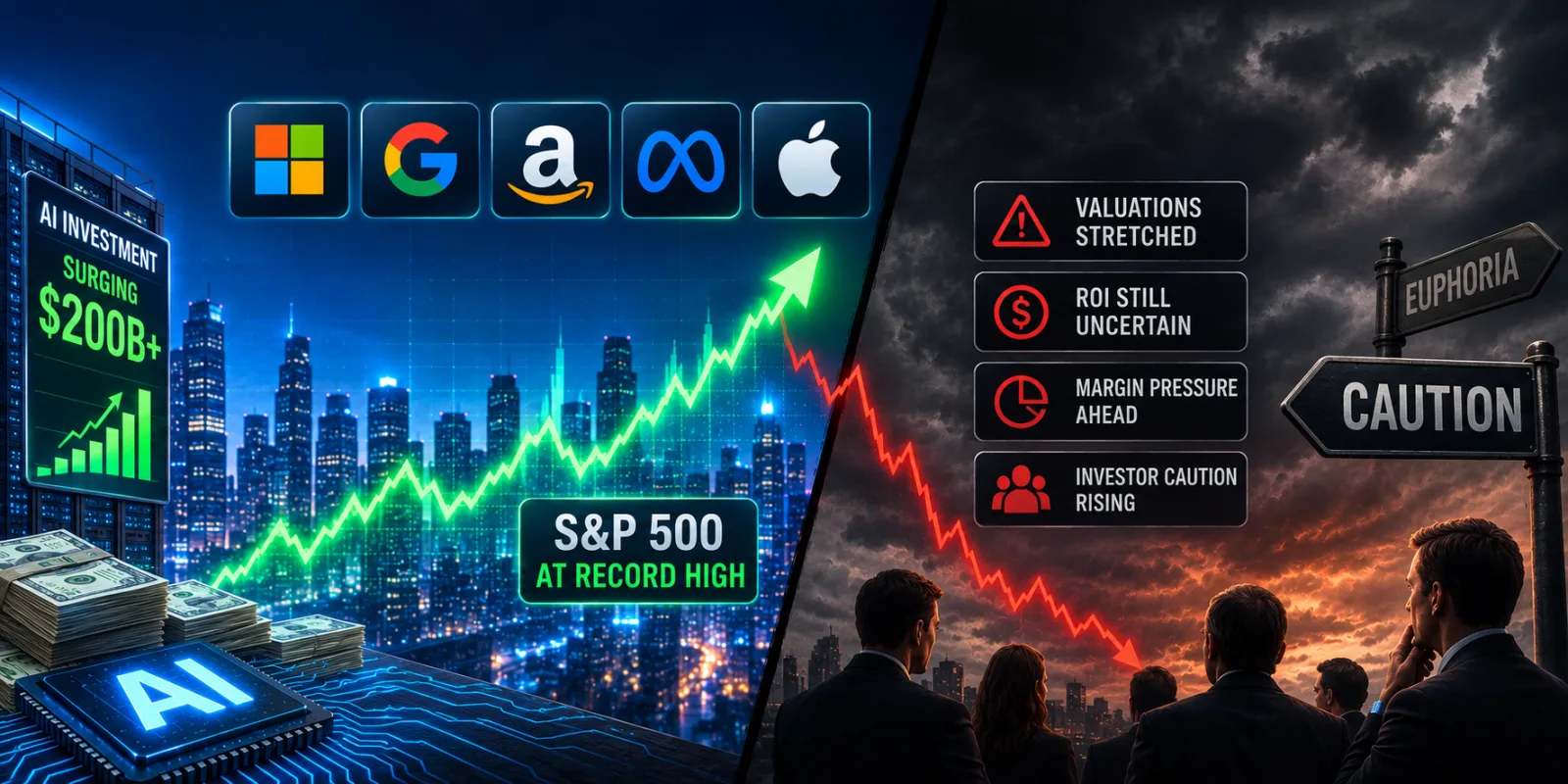
There is a moment in every boom when the number everyone is celebrating quietly becomes the number everyone is worried about. This week, that number is $725 billion.
That is roughly what the four largest US hyperscalers, Microsoft, Alphabet, Amazon and Meta, are now on course to spend on capital expenditure in 2026, most of it on the data centres, chips and power that feed artificial intelligence. The figure is up about 77% from 2025 (Yahoo Finance / Value Add VC). It is what carried the S&P 500 back to a record high on August 4. And it is exactly what made investors flinch a day later.
What happened#
On Tuesday, August 4, the AI trade did what it has done for most of the past three years: it lifted everything. The S&P 500 climbed 1.79% to close at 7,737, its first record high in two months. The Dow Jones Industrial Average jumped 907 points, or 1.7%, to a record 54,085.88, and the Nasdaq Composite rose 2.6% to 26,585 (TheStreet; CNN Business). The rally was explicitly pinned on "strong AI-linked earnings" and, secondarily, on fading geopolitical risk after reports of progress toward an Iran deal (NBC News).
The earnings underneath the move were genuinely strong. Alphabet lifted its full-year 2026 capex guidance to $195–205 billion after Google Cloud revenue grew 82% year over year to $24.8 billion and its cloud backlog swelled to $514 billion (Value Add VC). Amazon guided AWS capex to roughly $220 billion for 2026. Meta lifted the floor of its range to $130–145 billion. Microsoft set calendar-2026 capex near $190 billion, well above the $152 billion analysts had pencilled in (Uncover Alpha).
Then came Wednesday, August 5. The S&P 500 opened up about 0.6%, on track for a second straight record, before the mood turned and stocks slipped even as the Dow briefly notched a fresh intraday record (Bloomberg; TheStreet). The trigger was subtle but telling. SpaceX, in only its second earnings report as a listed-adjacent entity, posted record quarterly revenue of $7.8 billion, up 92% year over year, with its AI segment up 247% to $2.56 billion. Yet capex climbed above $18 billion, nearly $16 billion of it on AI, and the stock fell despite the beat, as investors zeroed in on the scale of the spend rather than the growth (Yahoo Finance, Morning Bid).
That is a real change from the "a beat is enough" dynamic that powered the AI trade all summer.
Why it matters#
For three years, AI capital spending and equity returns have moved in near lockstep. When a hyperscaler raised its capex guidance, its shares and the market usually went up, because bigger spending was read as proof of bigger demand. The signal this week is that the reflex may be weakening.
Two things make that shift consequential.
First, AI is no longer a sector story. It is the market. AI-linked companies have added roughly $27 trillion in value since late 2022, and by some counts now represent around 40% of total US market capitalisation (Stockpil; Morningstar). One analysis counts 218 companies directly exposed to the AI economy, worth $42.4 trillion, or 62% of the S&P 500 (Compare the Cloud). When the market and one theme become this fused, a rethink of that theme is not a rotation. It is the whole index.
Second, the spending is now large enough to be macroeconomic. Consensus forecasts for hyperscaler capex in 2026 have been revised about 30% higher over the past six months, to roughly $720 billion (Yahoo Finance). To put that in perspective, AI capex would need to reach around $700 billion in 2026 to match, in dollar terms, the peak of the late-1990s telecom investment cycle (American Century). As a share of GDP it is still smaller, around 0.8% versus 1.5% or more at prior booms' peaks, but the trajectory is what has central bankers paying attention.
Market impact#
The immediate market read is a story of dispersion rather than a broad sell-off. Semiconductors kept flying on Wednesday even as headline indices wobbled, because more hyperscaler capex still means more chip orders (MarketScreener). Nvidia, whose market value has already crossed $4 trillion, rose 2.56% on August 4 to $211.94, its fourth straight daily gain, and rallied further after Elon Musk touted SpaceX's compute build-out (itiger). Palantir had set the tone on Monday, surging about 29% on blockbuster results and a raised outlook (CNBC).
The macro backdrop is supportive, for now. Philadelphia Fed President Anna Paulson said on August 4 that she believes the current level of interest rates is sufficient to keep inflation moving toward the central bank's 2% goal (CNBC), a message the equity market took as a green light. But valuations leave little room for disappointment. The S&P 500's forward price-to-earnings ratio sits near 22.5x, with analysts projecting 14–15.5% earnings-per-share growth for 2026 (FinancialContent). At that multiple, the market is not just pricing in the spend. It is pricing in the payoff.
Winners and losers#
The clearest winners remain the picks-and-shovels suppliers. Chipmakers, memory manufacturers, networking firms and the power and cooling companies that outfit data centres capture hyperscaler dollars regardless of which cloud ultimately wins the AI race. Nvidia sits at the centre of that flow. Notably, Microsoft CFO Amy Hood attributed roughly $25 billion of the company's raised capex to higher memory-chip and component costs, a reminder that some of the "spending" is really the suppliers pricing in scarcity (Uncover Alpha).
Among the hyperscalers themselves, the market is starting to separate the crowd. Analysis this year has argued that Microsoft and Alphabet are best placed to justify their commitments because their AI spending reinforces cloud and advertising flywheels that already generate cash, while others risk spending simply to stay on the rails (The Motley Fool). That distinction is analytical, not settled fact, but it is increasingly how investors are framing the group.
The potential losers are the companies at the far end of the AI supply chain with the least to show for their investment: firms buying AI capability without a clear route to revenue, and the private start-ups whose valuations assume a payoff that may arrive late, or not at all. When capex is celebrated, everyone rises together. When capex is scrutinised, the market rewards those who can point to cash coming back.
Risks and limitations#
The loudest warnings this cycle are not about valuation. They are about leverage and concentration.
Over the past year the International Monetary Fund, the Bank for International Settlements and the Bank of England have each flagged that the financial plumbing around AI (leveraged ETFs, hedge-fund crowding, and opaque nonbank financing chains) is where a shock could turn systemic (Startup Fortune). The Bank of England's Financial Policy Committee has compared valuations of AI-focused technology firms to the dot-com peak of 25 years ago, and noted that market concentration has reached a 50-year high (CNBC). Its Prudential Regulation Authority has reportedly opened a review of UK prime brokerages' exposure to concentrated AI-linked bets in Asian equities.
The IMF's core concern is straightforward to state and hard to answer: rapid AI investment is propping up growth and markets today, but if the productivity gains fail to materialise, the leverage built up along the way could convert a growth disappointment into a sharp correction and a hit to household wealth (SAN). Morgan Stanley has named that scenario, "AI capital boom fails to boost productivity," as a key risk for 2026 (itiger).
There is also a subtler analytical caution, and this is commentary rather than reported fact: much of the AI economy's revenue is still circular, with tech companies buying from other tech companies. Circular demand can be real demand for a long time. It is also the kind of demand that unwinds quickly if end-customer budgets tighten.
What investors should watch next#
The signal to track is whether markets keep rewarding capex increases or start demanding evidence of return on that capex. The August 5 reaction to SpaceX and Nvidia, beats that were sold, is the first data point suggesting the bar has moved.
Beyond that, a short watch-list for the weeks ahead: cloud revenue growth rates and backlog conversion at the hyperscalers, since the whole thesis rests on demand catching up to supply; memory and component pricing, because rising input costs are quietly inflating capex figures; commentary from the Federal Reserve and other central banks on whether AI-driven investment is distorting their read of the cycle; and any follow-through from the Bank of England and IMF on concentration and leverage, which is where policy could eventually bite. For traders, dispersion within the AI complex, semis up while software or hyperscalers wobble, is worth more attention than the index level itself.
None of this means the boom is over. It means the market is beginning to ask harder questions, and the answers will increasingly come from cash flows rather than capex slides.
Frequently Asked Questions#
What is "hyperscaler capex" and why does it matter so much? Capex, or capital expenditure, is money a company spends on long-lived physical assets. For hyperscalers, the largest cloud operators, that now means data centres, AI chips, and the power and cooling to run them. It matters because these four companies alone are on course to spend more than $700 billion in 2026, a sum large enough to move both stock indices and the broader economy (Yahoo Finance).
Why did some stocks fall on August 5 even though earnings beat expectations? Investors appear to be shifting from rewarding the scale of AI spending to questioning it. SpaceX and Nvidia both beat estimates, but their shares fell as attention turned to how much is being spent on AI relative to the returns visible today (Yahoo Finance).
Is this an AI bubble? That is contested. The Bank of England has compared AI-focused tech valuations to the dot-com peak and flagged 50-year-high market concentration, while the IMF warns that leverage could amplify any correction (CNBC). Others argue the spending is backed by real, fast-growing cloud demand. As of now it is a live debate, not a settled verdict.
How exposed is the overall market to AI? Heavily. AI-linked companies have added around $27 trillion in value since late 2022 and represent roughly 40% of US market capitalisation, with some measures putting AI-exposed firms at 62% of the S&P 500 (Stockpil; Compare the Cloud).
What would change the story? Two things: clear evidence that AI investment is producing productivity gains and returns, which would support current valuations; or signs that demand is slowing while spending stays high, which would validate the leverage and concentration warnings.
Sources#
- S&P 500 Poised for Another Record as AI Spending Narrative Holds — Bloomberg
- Stock Market Today (Aug. 4, 2026) — TheStreet
- Stock Market Today (Aug. 5, 2026) — TheStreet
- The S&P 500 is back at a record high and the Dow just hit 54,000 — CNN Business
- S&P 500, Dow close at record highs on strong AI-linked earnings — NBC News
- Morning Bid: Semis fly again as AI capex shoots the moon — Yahoo Finance
- Google, Microsoft, Meta, Amazon capex to hit $725 billion in 2026 — Yahoo Finance / Value Add VC
- Amazon, Google, Microsoft, Meta Q2 earnings — Uncover Alpha
- Alphabet's $205B AI Capex Guidance 2026 — Value Add VC
- The $720 Billion Capex Trap — The Motley Fool
- Is Big Tech's AI CapEx Boom Sustainable? — American Century
- AI-Linked Companies Now Account for 62% of S&P 500 Market Cap — Compare the Cloud
- AI Stocks Now Account for 40% of the U.S. Stock Market — Stockpil
- 3 Years of the AI Stock Market Boom in Charts — Morningstar
- Central banks are warning that AI leverage is the real risk — Startup Fortune
- IMF and Bank of England join growing chorus warning of an AI bubble — CNBC
- Will AI drive a global boom or a bust? IMF report — SAN
- Morgan Stanley: Key 2026 Risk — itiger
- Nvidia's stock market value hits $4 trillion — itiger
- Stock market news for Aug. 3–4, 2026 (Palantir, Fed) — CNBC
- The 2026 Earnings Gauntlet — FinancialContent
- Semis fly again as AI capex shoots the moon — MarketScreener
Reporting in this article (index levels, earnings figures, capex guidance, official statements) is drawn from the primary and secondary sources linked above. Passages labelled as analysis or commentary reflect interpretation of that reporting and should not be taken as investment advice. This article is for information only and is not a recommendation to buy or sell any security.