AI Trade Storms Back as Hyperscaler Revenue Accelerates
A record S&P 500 close and the strongest week since April show the AI trade has recovered its footing as AWS and Azure growth reaccelerates — even as capex and macro risks build.
AI Trade Storms Back as Hyperscaler Revenue Accelerates#
The rally that was not supposed to happen#
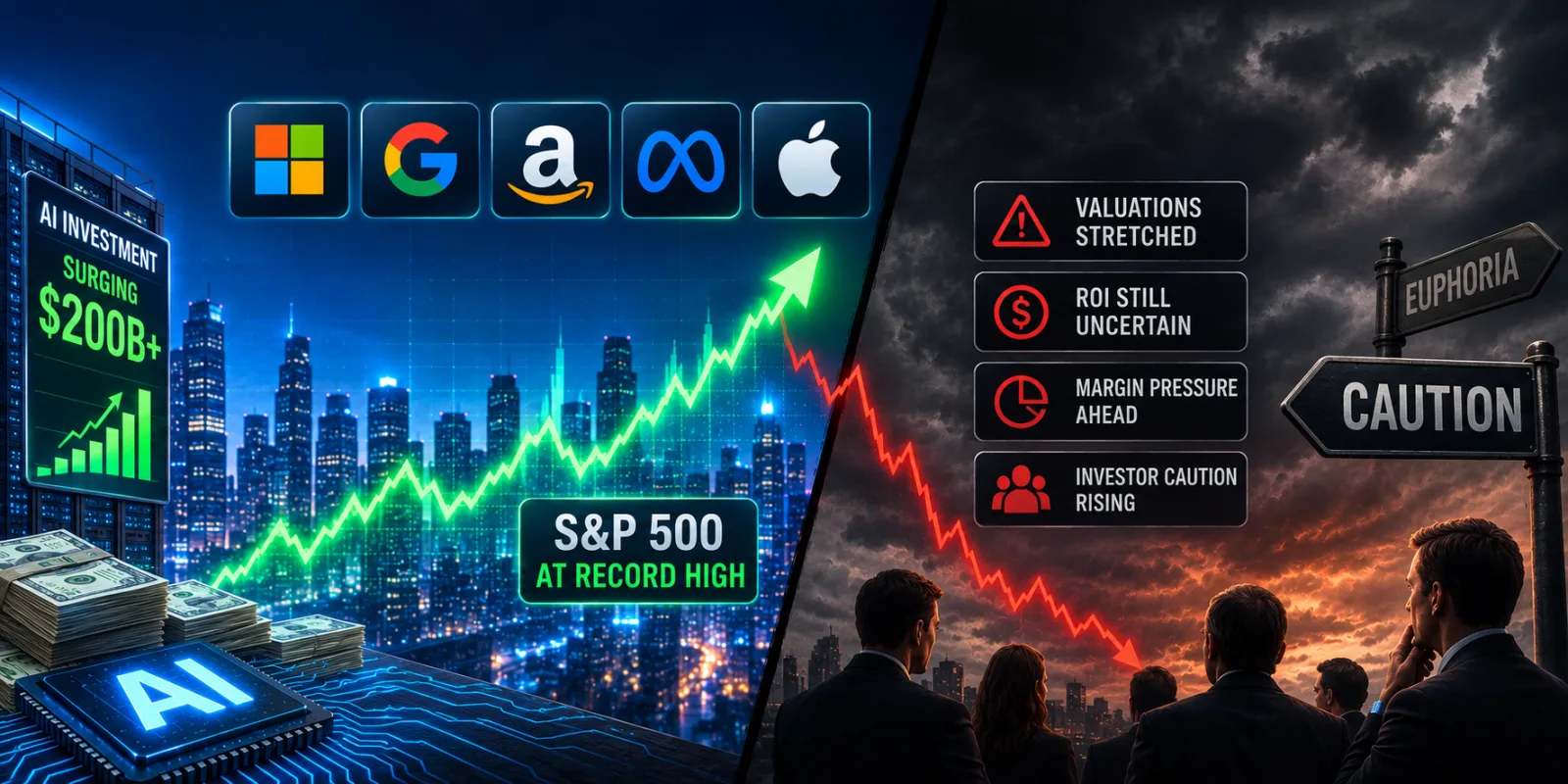
For much of 2026, the market's relationship with artificial intelligence has been a study in ambivalence. Investors wanted the growth but flinched at the bill. Then, in the first week of August, the mood flipped. The S&P 500 finished the week at a record close and logged its strongest five-day run since April, with the Nasdaq Composite up 5.2 per cent on the week and the Dow adding 3.0 per cent (CNBC, 6 August 2026). Bloomberg summarised the turn bluntly: big-tech shares had stormed back "as AI fears fade and euphoria resumes" (Bloomberg, 7 August 2026).
What makes the week worth dwelling on is not the price action alone but why it happened. The rebound was powered by two forces that rarely align so neatly: hard evidence that AI is now generating real, accelerating revenue at the largest cloud providers, and a soft labour-market print that revived hopes of easier monetary policy. For anyone allocating capital, the combination reframes the central question of the year: is AI spending a disciplined investment or the setup for an expensive hangover?
What happened#
Two catalysts did most of the work. The first was earnings. Amazon reported second-quarter revenue of $200.6bn, ahead of the roughly $196bn consensus, with Amazon Web Services growing 36.7 per cent year on year to $42.2bn, its fastest pace in eighteen quarters (CNBC, 30 July 2026). Management said its combined AI and custom-silicon businesses now run at an annual revenue rate of about $25bn, and lifted full-year capital-expenditure guidance to roughly $220bn (Investing.com earnings transcript, July 2026). Microsoft, reporting days earlier, said Azure had cleared $100bn in annual sales for the first time, with Azure and other cloud services revenue growing 39 per cent (Microsoft Investor Relations, FY26 Q2). The read-through was simple: the demand justifying the spending is showing up in the accounts.
The second catalyst was macroeconomic. The July employment report, released on 7 August, showed the US economy shed 23,000 jobs against expectations of an 80,000 gain, while the unemployment rate held at 4.1 per cent (CNN Business, 7 August 2026). The Bureau of Labor Statistics also cut a combined 103,000 jobs from its May and June estimates (NBC News, 7 August 2026). With inflation still a live concern in 2026, markets had been pricing a meaningful chance of a September rate rise; within hours those odds fell from about 57 per cent to 44 per cent (CNBC, 7 August 2026). Looser financial conditions and reaccelerating AI revenue arrived in the same news cycle, and equities did the rest.
Background: the "capex vigilantes" and why they matter#
To understand why this week counts as a genuine shift, rewind to the spring. The dominant market narrative was not AI optimism but AI anxiety, centred on capital expenditure. The four largest US hyperscalers, Alphabet, Amazon, Meta and Microsoft, are on course to spend roughly $725bn on capital projects in 2026, up about 77 per cent from $410bn the prior year (Fast Company). Much of that flows to data centres, Nvidia accelerators and power. Nvidia, for its part, posted a record quarter of $81.6bn in revenue, with data-centre sales of $75.2bn, up 92 per cent, the clearest measure of how much cash is being funnelled into AI compute (Value Add VC).
Spending on that scale forces a question every capital-allocation textbook asks: will the returns justify it? Through the first half of the year, sceptical investors (dubbed "capex vigilantes") answered by punishing any company that raised spending without a matching improvement in cash generation (Forbes, 1 August 2026). Microsoft's shares fell sharply earlier in the cycle on precisely this concern (Fortune, 26 July 2026). The vigilantes were making a legitimate point. Capex is a bet on future demand; if that demand disappoints, the depreciation lands on the income statement for years regardless. What changed in early August is that the revenue side finally accelerated fast enough (AWS's best growth in more than four years, Azure past a symbolic threshold) to make the spending look like a response to demand rather than a leap of faith.
Market implications#
The reverberations extend well beyond the technology sector.
In equities, the concentration risk is now unmistakable. A handful of AI-linked mega-caps drove the bulk of the weekly advance, and market breadth remains a concern even at record index levels. That leaves benchmark returns tightly coupled to a small number of capital-spending decisions. Passive and factor investors are, whether they intend to or not, running a large implicit long position in the AI infrastructure build-out.
In foreign exchange, the soft payrolls print sent the US Dollar Index down about 0.5 per cent to 99.43 (Babypips, 7 August 2026). A less hawkish Federal Reserve narrows rate differentials that had supported the dollar, with knock-on effects for carry trades and for emerging-market currencies that tend to rally when US real yields ease. The AI capex story also has an FX dimension of its own: the dollar-denominated build-out shapes cross-border capital flows toward US assets, and semiconductor supply chains concentrated in Asia link the trade to the Taiwan dollar, Korean won and Japanese yen.
In fixed income, Treasury yields fell on the jobs data, with the two-year down eight basis points to 4.16 per cent and the ten-year down six to 4.61 per cent (CNBC, 7 August 2026). Lower discount rates mechanically flatter long-duration equity valuations (precisely the profile of AI growth names), which is part of why the rally broadened into rate-sensitive utilities and REITs that stand to supply and house AI data-centre demand.
For banking and credit, the financing of the build-out is becoming a story in its own right. As hyperscaler free cash flow is absorbed by capex, more infrastructure is funded through debt, leases and off-balance-sheet vehicles, drawing private credit and asset managers into AI exposure. That broadens the set of institutions with a stake in the outcome and, with it, the potential for spillovers if demand forecasts prove optimistic.
Technical deep dive: reading capex as an option, not a certainty#
The cleanest way for a quantitative investor to think about hyperscaler AI spending is as a real option rather than a committed liability. Each data centre is a bet that future inference and training demand will monetise at a rate exceeding the cost of capital plus depreciation. The value of that option rises with demand volatility and with the credibility of the revenue ramp, which is exactly what this quarter's cloud numbers supplied.
Two metrics deserve attention. The first is the revenue-to-capex conversion rate: how much incremental cloud and AI revenue each dollar of capital spending generates, and how quickly. AWS growing at its fastest pace in eighteen quarters while capex guidance rises to about $220bn is encouraging, but the lag between spend and monetisation is the crux; GPUs depreciate on a three-to-six-year schedule, so a demand air-pocket would strand capital fast. The second is unit economics at the model layer. A widely cited MIT study found that roughly 95 per cent of enterprise generative-AI pilots delivered no measurable profit-and-loss impact, with the successful minority distinguished by agents wired into real institutional data rather than generic chatbots (Legal.io summary of the MIT report). Cloud revenue can accelerate even as end-customer ROI lags, because pilots consume compute whether or not they succeed. That gap between compute consumed and value realised is the fault line quantitative risk models should be stress-testing.
Critical analysis#
The bull case is now grounded in observable cash flows rather than narrative, which is a meaningful upgrade from the sentiment-driven moves of earlier in the year. Accelerating cloud growth, expanding AI run-rates and disciplined free-cash-flow management at Microsoft weaken the simplest bubble thesis.
The bear case has not gone away; it has become more specific. The Bank for International Settlements, in its 2026 Annual Economic Report, warned that an AI investment boom on the order of $1tn could be heading for a reckoning, and flagged near-record public debt and leveraged non-bank investors as amplifiers of any shock (Fortune, 29 June 2026). The IMF echoed the concern, noting that overly optimistic AI expectations raise the risk of overinvestment, resource misallocation and weaker credit quality, and pointing to the February 2026 sell-off in software-as-a-service shares as a live example of AI disrupting incumbents' business models. These are institutional voices, not perma-bears, and their warning is narrow: the demand justifying today's spending must not only exist but keep compounding for years.
There are practical adoption barriers too. If the MIT figure is even directionally right, the enterprise demand underwriting hyperscaler forecasts is thinner than the compute bills imply, and a pause in pilot budgets would hit cloud growth with a lag. Concentration is its own risk: an index led by a few capital-intensive names is fragile to a single guidance miss. And the macro relief that lit the fuse this week is double-edged: a labour market weak enough to justify rate cuts is also weak enough to dent the corporate IT budgets that feed AI demand.
Historical context#
Comparisons to the late-1990s telecoms build-out are inevitable and only partly apt. Then, as now, enormous capital chased a genuine technological shift; the fibre laid in 1999 was real and eventually indispensable, but the companies that laid it often did not survive to profit from it. The difference in 2026 is that today's spenders are among the most cash-generative businesses in history, funding much of the build from operating cash flow rather than speculative debt, which is why the shift toward debt and off-balance-sheet financing at the margin deserves watching.
The more useful frame is structural rather than cyclical. This is not a sentiment bounce of the kind seen in March, when the Nasdaq rebounded from its 2026 lows on renewed AI optimism alone. This week's move was validated by accounting: cloud revenue reaccelerated at scale. That points to a structural reallocation of corporate and investor capital toward AI infrastructure, of a magnitude that reshapes equity leadership, credit formation and even electricity markets. Whether it proves a durable regime or an overshoot will be decided not by any single week's earnings but by the persistence of the demand curve over the next several years.
Key takeaways#
- The early-August rally was validated by fundamentals, not just sentiment: AWS posted its fastest growth in eighteen quarters, and Azure cleared $100bn in annual sales, easing fears that AI spending lacked matching revenue.
- A weak July payrolls report (-23,000 jobs) cut the odds of a September Fed rate rise and loosened financial conditions, amplifying the equity move and weakening the dollar.
- Hyperscaler capex of roughly $725bn in 2026 remains the pivotal variable; the debate has shifted from "is there demand?" to "will demand compound fast enough to justify the depreciation?"
- Concentration and financing risks are rising as index returns hinge on a few names and more of the build-out is funded through debt and private credit.
- Official-sector bodies (the BIS and IMF) are explicitly flagging overinvestment and financial-stability risks, a signal that the AI capital cycle is now a macroprudential concern, not just an equity-market one.
Frequently asked questions#
Why did stocks rise on a bad jobs report? Because in 2026 markets had been pricing a possible Fed rate rise. A weak labour print cut those odds, implying easier policy and lower discount rates, which benefits long-duration growth equities most (CNBC).
Is this an AI bubble? Opinions differ. Accelerating cloud revenue supports the view that spending reflects real demand. The BIS and IMF counter that expectations may still be too optimistic, raising overinvestment risk (BIS via Fortune; IMF). This piece takes no view on future prices.
What are "capex vigilantes"? Investors who sell shares of companies that raise capital spending without a commensurate improvement in cash generation, effectively disciplining management through the share price (Forbes).
How does this affect foreign exchange? Softer US data pushed the Dollar Index down about 0.5 per cent to 99.43 as rate-cut expectations grew, with implications for carry trades and emerging-market currencies (Babypips).
Why does the MIT pilot-failure study matter to markets? It suggests the enterprise ROI underwriting hyperscaler demand forecasts may be thinner than compute spending implies, a lag that could pressure cloud growth if pilot budgets pause (Legal.io).
Which sectors beyond tech benefit? Utilities, REITs and power infrastructure tied to data-centre demand rallied, helped by falling yields (Investrade).
What should quantitative investors watch next? The revenue-to-capex conversion rate, GPU depreciation schedules, enterprise pilot-to-production conversion, and the financing mix of the build-out as it shifts toward debt and off-balance-sheet vehicles.
References#
- Big Tech Stocks Storm Back as AI Fears Fade and Euphoria Resumes — Bloomberg, 7 August 2026.
- S&P 500 rises to record close Friday and posts strongest week since April — CNBC, 6 August 2026.
- Stock Market Today (Aug. 7, 2026): Nasdaq rises after July jobs report — TheStreet, 7 August 2026.
- Market Review: August 07, 2026 — Investrade.
- Amazon (AMZN) Q2 earnings report 2026 — CNBC, 30 July 2026.
- Earnings call transcript: Amazon tops Q2 2026 estimates as AWS growth accelerates — Investing.com.
- FY26 Q2 Intelligent Cloud Performance — Microsoft Investor Relations.
- The US economy unexpectedly lost 23,000 jobs last month — CNN Business, 7 August 2026.
- Job losses in July and negative revisions reveal a weakening US labour market — NBC News, 7 August 2026.
- Odds the Fed hikes in September tumble following big July jobs miss — CNBC, 7 August 2026.
- Treasury yields drop after surprise jobs loss in July — CNBC, 7 August 2026.
- US Jobs Report July 2026 Came in Soft — Babypips, 7 August 2026.
- Big Tech capex ranked — Fast Company.
- Big Tech Earnings 2026: Apple, Nvidia & More — Value Add VC.
- Big Tech Faces Capex Vigilantes As Earnings Surge — Forbes, 1 August 2026.
- Big Tech earnings slam into a market in revolt over AI spending — Fortune, 26 July 2026.
- The central bank of central banks just released its flagship annual report — Fortune on BIS Annual Economic Report 2026, 29 June 2026.
- How Central Banks Can Contain Financial Stability Risks as AI Accelerates Change — IMF, 23 July 2026.
- MIT Report Finds 95% of AI Pilots Fail to Deliver ROI — Legal.io summary of MIT "State of AI in Business" report (working research, not peer reviewed).
This article is for information only and is not investment advice, a recommendation, or an offer to buy or sell any security. Figures are drawn from the cited sources and reflect data available at the time of writing; market interpretation and forward-looking statements are clearly framed as such and are estimates, not certainties.