When the AI Trade Turned on Itself
Leopold Aschenbrenner's Situational Awareness LP lost roughly two-thirds of its value in July and sold a $16bn book to Citadel. The episode is a case study in AI-era crowding, leverage and the fragility of a consensus trade.
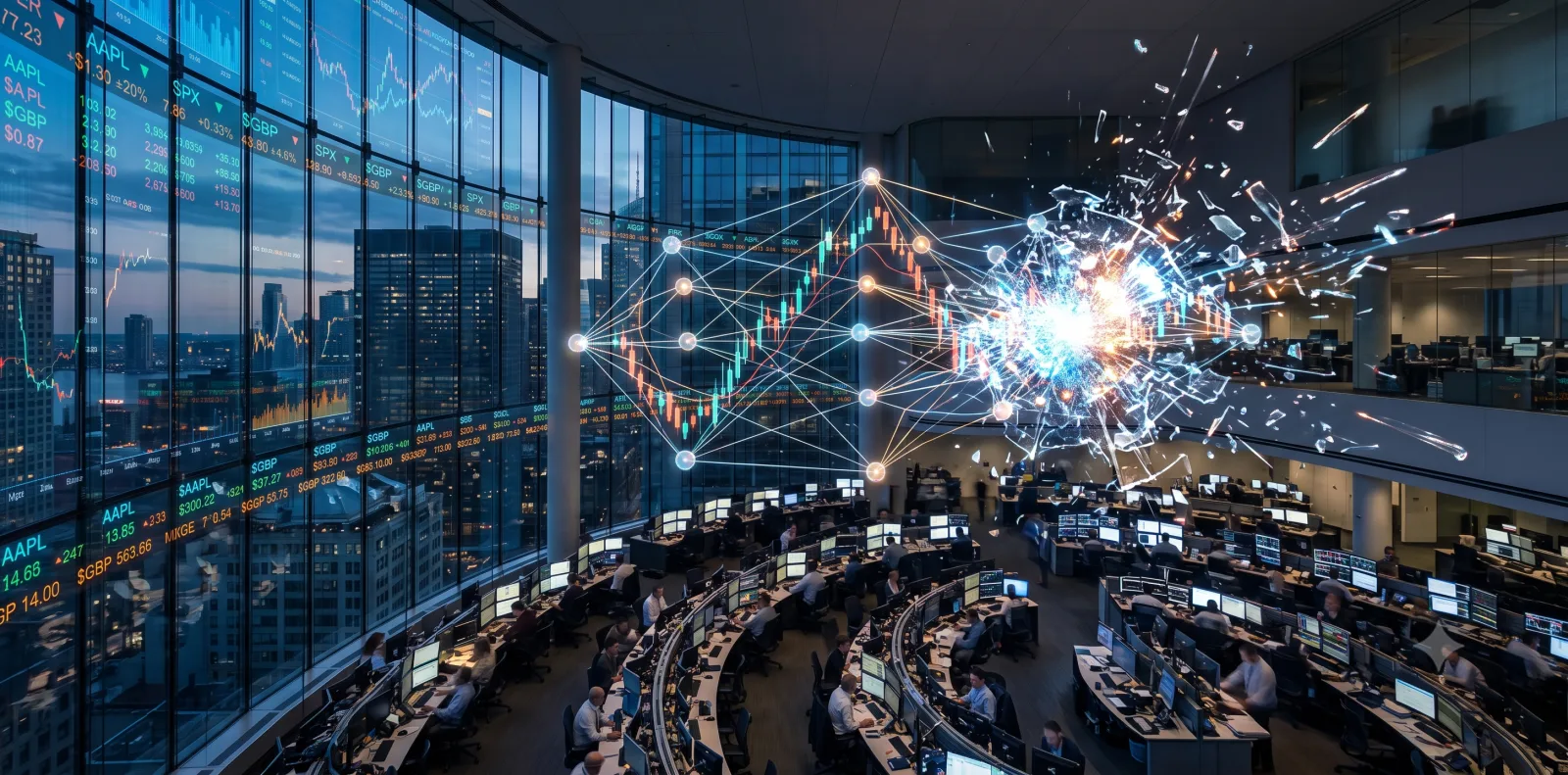
For three years the most reliable idea in global markets was also the simplest: own the companies building artificial intelligence, and short the ones it might displace. In July 2026 that idea broke, and it broke in a way that should interest anyone who runs money for a living. The most instructive casualty was not a struggling manager but one of the year's best performers, undone not by a bad thesis but by the sheer weight of everyone agreeing with it.
What happened#
Situational Awareness LP, the AI-thesis fund run by 24-year-old former OpenAI researcher Leopold Aschenbrenner, sold its entire public-equity book (longs and shorts together) to Ken Griffin's Citadel in a single privately negotiated block around 30 July, according to reporting by CNBC and a detailed reconstruction by SpotGamma. The portfolio was valued at roughly $16bn and changed hands at an estimated 10% discount.
The numbers are worth pausing on. The fund had returned about 439% net in the first half of 2026 and had swelled to around $20bn, before losing roughly 67% of its value in July alone, per Cryptobriefing and Quartz. The structure that produced the gains also produced the collapse: the book ran at roughly four-times leverage, so moves were magnified fourfold on both sides. When AI-infrastructure longs fell more than 35% and the software names it had shorted rallied, prime brokers Goldman Sachs, JPMorgan and Bank of America issued margin calls. The fund's remaining assets (around $10bn, including an unlisted stake in Anthropic) leave it still up on the year, but the public trade is gone.
Aschenbrenner's fund was the largest single casualty, not an isolated one. Over the same stretch the Philadelphia Semiconductor Index fell 28.6% from its 22 June peak and the Morgan Stanley Momentum TMT Index dropped 53.5%, while "neocloud" names Nebius and CoreWeave shed 43% and 36% respectively, according to Tech Times. Even the multi-strategy giants felt it: Bloomberg reported that Millennium Management lost 2.1% in July as the AI trade whipsawed its equity pods.
Background: what a crowded trade actually is#
To see why a winning fund can implode without changing its mind, it helps to separate two things that ordinarily move together: a position's thesis and its financing.
A "crowded" trade is one where a large share of active capital holds the same exposure. Crowding is invisible while prices rise; it shows up only on the way down, because the same investors reach for the exit through the same door. When those positions are financed with borrowed money, the exit narrows further. Leverage forces sellers to act on the lender's timetable, not their own: a margin call converts a long-term conviction into an immediate liquidity problem. That is the mechanism behind most violent unwinds, from Long-Term Capital Management in 1998 to the Archegos collapse in 2021, and it is exactly what played out here.
Two features made the 2026 version distinctive. First, the catalyst came from credit rather than earnings. As SpotGamma noted, credit-default-swap costs on AI-infrastructure borrowers rose sharply as investors began to question whether the sector's enormous capital-expenditure programme could be financed at sustainable rates, a concern the Bank for International Settlements had flagged in its June annual report, naming AI capex as one of four "pressure points" for the global economy. Second, the crowding was measurable in advance. In May, Goldman Sachs recorded momentum positioning in AI-related equities at the 100th percentile of its five-year dataset (the literal ceiling) on a day its high-beta momentum basket fell 8%, one of its sharpest sessions since 2021.
Market implications#
The most immediate lesson is about correlation, not direction. Multi-strategy "pod shops" market themselves on diversification: dozens of teams, many strategies, tight risk limits. BlackRock has warned that these platforms may be far more correlated, and therefore more fragile, than their headline diversification metrics imply. July supplied the evidence. When the AI factor unwound, it did not respect the boundaries between a specialist tech fund, a systematic momentum book and a discretionary pod; they were all, in effect, long the same thing.
For equities, the near-term damage has been partly repaired. A risk-on turn in early August (helped by an easing in geopolitical tension) sent CoreWeave up almost 20% in a session and Nebius up roughly 27%, with Oracle and Snowflake also recovering, according to 24/7 Wall St. But those moves recover a fraction of the drawdown; both names remain down or flat over thirty days. The next genuine test is CoreWeave's earnings on 11 August, which will show whether AI-cloud demand is converting into a credible path to profit or merely into more debt-financed capacity.
For foreign exchange and fixed income, the read-across is indirect but real. The episode is a reminder that AI-linked credit is now large enough to transmit stress into funding markets. With the Federal Reserve holding its policy rate at 3.50%–3.75% for a fifth consecutive meeting, according to CNBC, the cost of financing leveraged equity books is unlikely to fall soon, which keeps the "financing" side of every crowded trade tight. A dollar that stays firm on higher-for-longer rates compounds the pressure on globally financed AI-infrastructure borrowers.
Technical deep dive: is AI compressing the crowding cycle?#
The sharpest question for quantitative researchers is whether AI itself is shortening the interval between a trade becoming consensus and becoming dangerous. Citadel's head of quantitative research has framed it as a paradox, as summarised in Hedge Think: AI infrastructure compresses research timelines, surfaces signals faster and enables rapid repositioning, yet those same efficiencies accelerate crowding, because when AI helps one firm identify a risk earlier, it helps every firm identify it earlier, triggering correlated exits that deepen the dislocation each was trying to avoid.
There is a mechanical version of this concern that regulators have named: model herding. If many firms train on overlapping data, fine-tune similar foundation models and optimise against comparable objectives, their outputs converge, and large language models compound the effect, since their behaviour is highly sensitive to prompts. The IMF has noted that as algorithms standardise, the risk of herding and procyclicality grows, contributing to flash crashes and illiquidity in stress. IOSCO's May 2026 Supervisory Toolkit for AI Use in Capital Markets and the Financial Stability Board's monitoring work both single out concentration in models, data and infrastructure as a systemic channel distinct from any single firm's risk-taking.
None of this means AI-driven strategies do not work. The reported outperformance of advanced AI approaches over traditional quant methods is real, and systematic funds such as the $7.2bn Quantedge (up 7.8% in July and 34.6% for the year) showed that diversified, cross-asset models could profit precisely because they were not on the crowded side of the AI trade. The point is subtler: an edge that everyone can now compute faster is an edge that decays faster, and decays for everyone at once.
Critical analysis#
It would be easy, and wrong, to read July as a verdict on the AI thesis. The infrastructure build-out is real, and the rebound suggests the market still believes the demand is too. What failed was not the idea but its implementation: specifically, the combination of extreme conviction, four-times leverage and a position so consensus that its unwind became self-reinforcing.
The limitations of the bearish narrative deserve equal weight. Situational Awareness remains up around 80% on the year; Citadel bought the book because it saw value, not because the assets were worthless; and forced selling by a leveraged holder tells you about that holder's balance sheet, not about fair value. Reasonable investors can look at the same drawdown and conclude either that the AI trade is structurally fragile or that it simply shook out its most reckless participants. Both readings are defensible on the current evidence.
The harder, unresolved risk is structural. If AI genuinely compresses the crowding cycle, then the frequency and violence of these unwinds should rise even as each individual firm behaves prudently, a classic composition problem that no single risk desk can solve alone. That is the scenario regulators are circling, and it is the one worth watching, because it would change how much leverage the system can safely carry.
Historical context#
Crowded, leveraged unwinds are not new. The 2007 "quant quake", when statistical-arbitrage funds deleveraged into one another over a few August days, is the closest analogue in mechanism, and the parallel is uncomfortable: like 2007, July 2026 featured sophisticated managers with similar models discovering they held the same book. Archegos in 2021 supplies the leverage template: concentrated, prime-broker-financed positions collapsing on margin calls.
What is new is the accelerant. Earlier episodes were amplified by shared models; this one by shared models that increasingly write and refine themselves. That makes July 2026 less a repeat of 2007 than an early instance of a structural shift: the first stress test of markets in which the tools that find the trade and the tools that exit it are the same tools, running across nearly every serious participant at once.
Key takeaways#
The five points worth carrying forward. First, the danger was crowding and leverage, not the AI thesis; a fund up 439% still lost two-thirds of its value without changing its mind. Second, credit, not earnings, was the trigger, as CDS costs on AI-infrastructure borrowers rose. Third, pod-shop diversification proved thinner than advertised when a single factor unwound. Fourth, regulators (BIS, IOSCO, FSB, IMF) had already named model herding and AI-capex concentration as systemic channels. Fifth, the open question is whether AI is compressing the crowding cycle, making prudent firms collectively fragile.
Frequently asked questions#
What is Situational Awareness LP? A hedge fund founded by Leopold Aschenbrenner, a former OpenAI researcher, built around a concentrated, leveraged bet on the AI build-out. It returned roughly 439% in the first half of 2026 before losing about 67% in July.
Why did it have to sell to Citadel? Its roughly four-times leverage meant that falling AI-infrastructure longs and rising software shorts triggered margin calls from its prime brokers, forcing a fast sale of the whole public book at an estimated 10% discount.
Did the AI thesis fail? Not obviously. The fund remains up around 80% for the year on retained private holdings, and AI stocks rebounded in early August. What failed was the crowded, leveraged expression of the thesis.
What is a crowded trade? One held by a large share of active capital. It looks safe while prices rise but becomes dangerous on the way down, because everyone exits through the same narrow door, a problem magnified by leverage.
What is model herding? The risk that firms using similar data, foundation models and objectives generate correlated positions and correlated exits, amplifying volatility. Regulators including the IMF and IOSCO have flagged it as a distinct systemic risk.
Is this like the 2007 quant quake? In mechanism, yes: similar models deleveraging into one another. The difference is that today's models increasingly build and refine themselves, which may shorten the crowding cycle.
What should investors watch next? CoreWeave's 11 August earnings, the cost of AI-infrastructure credit, and momentum-positioning gauges that flag when a trade is again near the top of its range.
References#
Note: figures cited from financial journalism reflect reporting as of early August 2026 and, where sources differ on peak fund size, the more conservative figure has been used. Market interpretation and forward-looking statements are identified as such and are not investment advice.
- CNBC — Why AI investor Leopold Aschenbrenner is selling all stocks
- SpotGamma — Anatomy of a Margin Call: How Situational Awareness LP Unwound a $20 Billion AI Book
- Cryptobriefing — Situational Awareness loses 67% in July, sells $16B portfolio to Citadel
- Quartz — Leopold Aschenbrenner's AI hedge fund collapses after margin calls
- Tech Times — Citadel Buys Situational Awareness Portfolio as 4x Leverage Ends AI Fund's Run
- Bloomberg — Millennium Lost 2% Last Month as AI Trade Whipsawed Hedge Funds
- 24/7 Wall St — CoreWeave Jumps, Snowflake and Oracle Gain as Risk-On Mood Lifts AI Cloud
- CNBC — Fed meeting recap: July 2026
- Bank for International Settlements, Annual Economic Report 2026, via Let's Data Science summary
- IOSCO — Supervisory Toolkit for AI Use in Capital Markets (FR/02/2026, May 2026)
- Financial Stability Board — Monitoring Adoption of Artificial Intelligence and Related Vulnerabilities (2026)
- IMF — How Agentic AI Will Reshape Payments (NOTE/2026/004)
- HedgeThink — The Rise of AI-First Hedge Funds: What Investors Should Watch in 2026