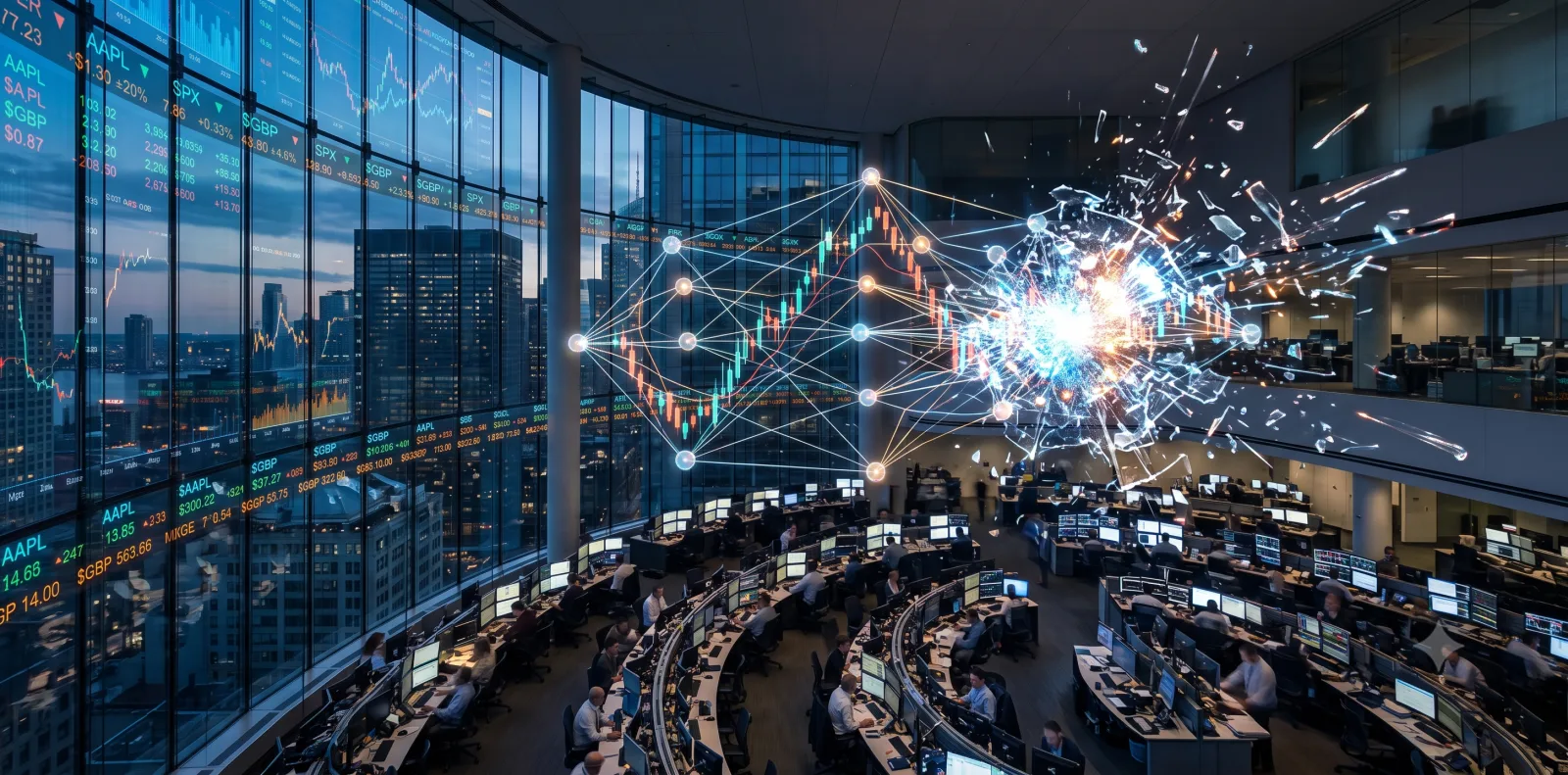
AI Is Shrinking Wall Street's Edge to 18 Months
New research and a Bloomberg feature converge on the same warning: AI is collapsing the half-life of trading signals and herding capital into the same positions. Here is what it means for quants, allocators and regulators.

For thirty years the promise of quantitative finance was simple. Find a genuine statistical edge, protect it, and harvest it for as long as the crowd stayed away. This week that promise looks a good deal shorter-dated. A Bloomberg feature published on 2 August profiled retail traders wiring together hedge-fund-style bots in their spare bedrooms, and in doing so crystallised an anxiety that has been building across Wall Street all summer: when everyone runs a similar model, everyone ends up in the same trade, and the edge that once lasted years now evaporates in months.
Executive Summary#
The most important development at the intersection of AI and finance is not a new model or a funding round; it is a growing body of evidence that artificial intelligence is compressing the useful life of trading signals and pushing portfolios toward one another. Bloomberg's reporting that AI is turning ordinary investors into "DIY hedge funds" (Bloomberg, 2 August 2026) sits atop a formal research finding: a New York University working paper estimates that the half-life of a profitable signal has fallen to roughly 18 months, against five to seven years before AI became ubiquitous (Meng and Chen, 2026). Regulators are paying attention. The Financial Stability Board is finalising its first framework on responsible AI adoption (FSB, June 2026), and the Bank for International Settlements has flagged correlated AI trading as a stability concern (BIS, June 2026). For quants, the question is no longer whether AI finds alpha, but how quickly it destroys it.
What Happened?#
Two threads came together this week. The first is cultural and commercial. Bloomberg profiled Joel Rieger, a software-sales executive who spent more than a year building an automated options programme from a home office in Los Angeles, only to find his returns barely beat a passive S&P 500 index fund (Bloomberg, 2 August 2026). No-code and AI-assisted platforms (Composer, Alpaca and QuantConnect among them) now let non-programmers design, backtest and deploy systematic strategies. QuantConnect alone reports having deployed more than 375,000 live strategies since 2012 (QuantConnect). The democratisation is real, and so is its shadow: Cboe data cited by Bloomberg shows retail options activity clustering at predictable moments such as 10 a.m., as automated systems fire on a schedule.
The second thread is analytical. In July, Bloomberg reported on a research model suggesting a profitable signal could now lose half its excess return in about 18 months, down from five to seven years before AI became widespread (Bloomberg, 1 July 2026). The underlying paper, "AI-Driven Alpha Decay" by Shuchen Meng and Xupeng Chen of NYU, formalises the intuition and provides the number (Meng and Chen, 2026, Preprint, not peer reviewed). Taken together, the two threads describe a single phenomenon at two ends of the market: the same models, the same data and the same conclusions, arrived at by more and more participants at roughly the same time.
Background: What "Alpha Decay" Actually Means#
Alpha is the return a strategy earns above what its risk exposures would predict. Alpha decay is the well-documented tendency for that excess return to erode once a signal becomes known and traded. The mechanism is mean reversion: as capital floods a mispricing, prices adjust and the opportunity closes. Classical market-efficiency theory treats this as healthy: arbitrage is the process by which prices become informative.
What is new is the speed. The NYU authors model the alpha half-life as h(φ) = ln 2 / [θ + δ(φ)], where θ is the natural mean-reversion rate and δ(φ) is an AI-accelerated decay term that rises with adoption φ and with the correlation ρ between market participants' signals (Meng and Chen, 2026). In plain terms, the more players who use similar AI systems, and the more alike their conclusions, the faster any given edge is competed away. Calibrated to current conditions (the authors assume roughly 70% adoption and a signal correlation near 0.6), the model spits out that 18-month half-life. The edge has not disappeared; its clock has simply sped up.
Market Implications#
For quantitative and multi-strategy funds, faster decay changes the economics of research. If a signal's useful life falls by two-thirds, the fixed cost of discovering it must be amortised over a much shorter harvest. That pressures the whole sausage machine of factor research and rewards firms that can find, deploy and retire signals at speed. It also raises the premium on genuinely differentiated inputs (proprietary alternative data, unusual execution venues, capacity-constrained niches) over the crowded, well-trodden factors that AI systems converge on.
For market structure and financial stability, the concern is correlation. The NYU paper calibrates a portfolio-convergence measure to SEC Form 13F filings (99.5 million holdings between 2013 and 2024) and finds simulated convergence rising by about 42% over the sample, with structural breaks around major AI-adoption waves (Meng and Chen, 2026). When positions overlap, exits become synchronised, and synchronised exits are how orderly markets become disorderly ones. That is precisely the fragility on display in 2026's quant tremors: US-focused systematic funds fell around 2.8% in the first two weeks of January as crowded trades unwound, according to UBS prime-book estimates, with Goldman Sachs attributing the drawdown to losses in crowded positions and forced deleveraging (Bloomberg, 21 January 2026).
For regulators, the file is now open. The FSB's June consultation set out twelve sound practices spanning governance, data, explainability and human oversight, with a final report due in October 2026 (FSB, June 2026). The BIS has warned that overly optimistic expectations about AI raise the risk of "overinvestment, resource misallocation and weaker credit quality" (BIS Bulletin 130, 2026). Homogenisation of trading behaviour is the market-microstructure counterpart to those macro worries.
For retail and fintech, the levelling of the playing field is double-edged. The tools are genuinely powerful, but predictability is a liability: if bots cluster their orders, more sophisticated participants can anticipate and trade against that flow. Democratised alpha can quickly become democratised beta with extra fees.
Technical Deep Dive: Three Channels of Erosion#
The NYU framework identifies three mutually reinforcing channels (Meng and Chen, 2026). The first is signal crowding: the classical effect, where shared discovery compresses returns. The second is performative signal erosion, a subtler and more modern idea: when AI models are trained on market data that already reflects AI-driven trading, the very act of prediction changes the thing being predicted, attenuating the coefficients over successive retraining cycles. The third is Red Queen competition, borrowed from evolutionary biology: participants must keep investing in ever more sophisticated AI simply to stand still, because everyone else is doing the same. The authors' policy section even floats a Pigouvian tax on correlated algorithmic trading and signal-diversity requirements, ideas that will strike many practitioners as heavy-handed but which signal where the academic conversation is heading.
A second, independent line of research exposes a related vulnerability: fragility to manipulation. In a paper accepted at the IEEE Conference on Secure and Trustworthy Machine Learning, Rizvani, Apruzzese and Laskov built a realistic trading system fusing an LSTM price forecast with sentiment from nine language models (FinBERT, FinGPT, FinLLaMA and six general-purpose LLMs), and showed that altering news headlines on a single day, using tricks invisible to human readers such as Unicode homoglyph swaps and hidden text, could cut annual returns by up to 17.7 percentage points (Rizvani et al., 2026, Preprint, not peer reviewed). When many funds ingest the same news feeds through similar models, a single poisoned headline becomes a systemic input, not an isolated error.
Critical Analysis#
The evidence deserves scepticism as well as attention. Both central results are working papers rather than peer-reviewed findings, and the headline 18-month figure is the output of a calibrated model, not a directly observed statistic. The parameter choices (70% adoption, 0.6 signal correlation) are assumptions, and reasonable analysts could pick others that yield materially different half-lives. The 42% convergence figure is derived from a simulation anchored to 13F data, which captures long US equity positions quarterly and misses derivatives, shorts and intra-quarter turnover.
There are also countervailing forces the crowding thesis can understate. Markets have absorbed successive waves of new technology (program trading, statistical arbitrage, high-frequency trading), and each time the predicted homogenisation was partly offset by adaptation, capacity limits and the emergence of new, less crowded strategies. AI may erode old signals while simultaneously lowering the cost of discovering new ones, keeping the treadmill moving rather than stopping it. And genuine differentiation still exists: the funds that persistently outperform tend to do so through proprietary data and execution, exactly the moats that generic models cannot replicate. The reasonable reading is not that alpha is dead, but that its shelf life is shortening and its failure modes are becoming more correlated.
Historical Context#
Is this a paradigm shift or a familiar cycle in new clothing? The honest answer is a bit of both. The dynamic itself (profitable ideas attracting capital until they stop working) is as old as markets. What is arguably structural is the compression of the timescale and the correlation of the participants. The August 2007 quant quake showed how quickly crowded, similar strategies could unwind in concert; the 2010 Flash Crash, which the NYU paper revisits, showed how algorithmic homogeneity can turn a liquidity shock into a cascade. The difference in 2026 is scope. Where crowding was once confined to a few dozen elite quant shops, AI extends the same models, the same training data and the same reflexes to boutique funds and bedroom traders alike. That broadening (from an exclusive club to a mass phenomenon) is what makes today's development feel less like a repeat and more like a change of state.
Key Takeaways#
- The clock on alpha has sped up. Research now estimates the half-life of a trading signal at roughly 18 months, down from five to seven years, driven by AI adoption and rising signal correlation (Meng and Chen, 2026).
- Crowding is measurable and rising. Simulated portfolio convergence increased about 42% over 2013–2024, with breaks around AI-adoption waves, and 2026's quant drawdowns show what synchronised exits look like in practice.
- Homogenisation is now a stability question. The FSB and BIS are treating correlated AI trading as a systemic issue, with an FSB framework due in October 2026.
- Shared models create shared vulnerabilities. A single manipulated headline can degrade many LLM-driven strategies at once, cutting returns by up to 17.7 percentage points in controlled tests (Rizvani et al., 2026).
- Differentiation is the durable edge. Proprietary data, capacity-constrained niches and distinctive execution matter more as generic factors decay faster.
Frequently Asked Questions#
What is alpha decay? It is the erosion of a strategy's excess return once its signal becomes known and widely traded, as capital arbitrages away the mispricing.
Why would AI make it worse? Because widely available AI systems trained on similar data tend to reach similar conclusions, so more participants crowd the same trades faster, compressing returns (Meng and Chen, 2026).
Is the 18-month figure a fact? No. It is the output of a calibrated theoretical model in a working paper, dependent on assumptions about adoption and correlation. Treat it as an estimate, not a measurement.
Does this mean quant strategies no longer work? Not at all. It suggests signals decay faster and require quicker discovery and retirement, raising the value of genuinely differentiated inputs.
How does crowding threaten stability? Overlapping positions make exits synchronised; when many funds sell the same names at once, an ordinary shock can cascade, as seen in 2026's quant drawdowns.
What are regulators doing? The FSB has consulted on twelve sound practices for AI adoption and will publish a final report in October 2026; the BIS has flagged AI-related overinvestment and correlated-trading risks.
Can retail bots really compete with hedge funds? They can access similar tools, but Bloomberg's reporting suggests results often lag simple index funds, and clustered, predictable order flow can be exploited by more sophisticated players (Bloomberg, 2 August 2026).
Should investors change their portfolios because of this? This article is analysis, not advice. Nothing here is a recommendation to buy, sell or allocate; consult a qualified adviser for decisions specific to your circumstances.
References#
- Bloomberg (2 August 2026). AI-Powered Trading Bots Help Retail Investors Take On Hedge Funds.
- Bloomberg (1 July 2026). Wall Street's AI Race Is Fueling New Fears of Crowded Trading.
- Bloomberg (21 January 2026). Quants in Worst Drawdown Since October as Crowded Bets Buckle.
- Meng, S. and Chen, X. (23 March 2026). AI-Driven Alpha Decay: Algorithmic Homogenization, Reflexive Signal Erosion, and the Paradox of Intelligent Markets. arXiv:2605.23905 [q-fin.GN]. Preprint, not peer reviewed.
- Rizvani, A., Apruzzese, G. and Laskov, P. (19 January 2026). Adversarial News and Lost Profits: Manipulating Headlines in LLM-Driven Algorithmic Trading. arXiv:2601.13082 [cs.CR]; accepted, IEEE SaTML 2026. Preprint, not peer reviewed.
- Financial Stability Board (10 June 2026). Sound Practices for the Responsible Adoption of Artificial Intelligence (AI): Consultation Report.
- Bank for International Settlements (June 2026). Annual Economic Report 2026, Chapter I: Progress and Peril.
- Bank for International Settlements. BIS Bulletin No. 130: AI and the Global Economy — Implications for Central Banks.
- QuantConnect. Platform overview and live-strategy statistics.
Editorial note: This article distinguishes verified facts (dated reports, published figures) from model-derived estimates and forward-looking interpretation. Working papers are labelled as not peer reviewed. It is intended for professional and educational use and does not constitute investment advice.