The AI Momentum Unwind: Quant's Worst Month
Goldman's high-beta momentum basket has just logged its worst month on record even as the S&P 500 sets fresh highs. Inside the summer 2026 quant unwind, its causes, and its echoes of August 2007.
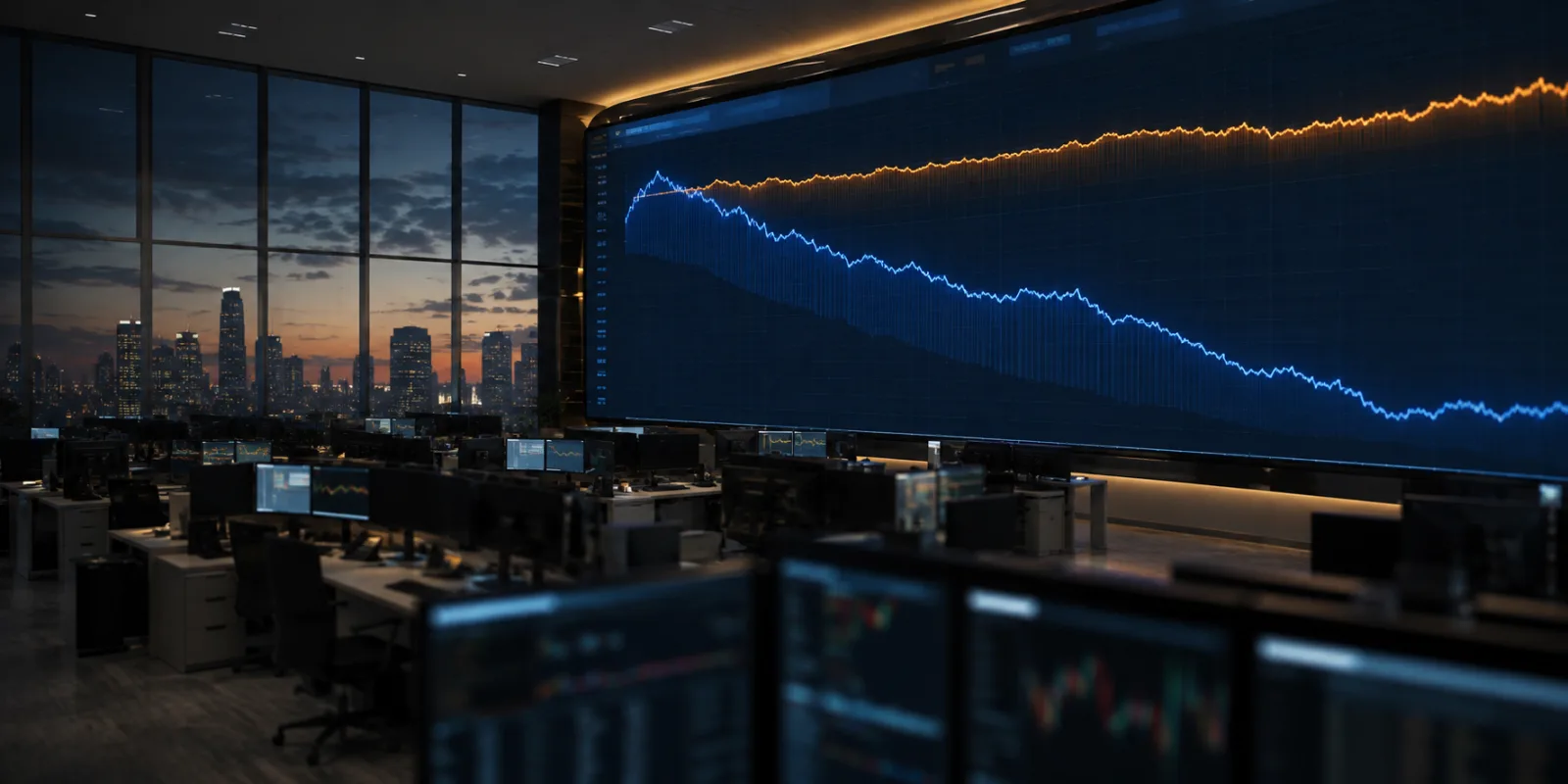
Pick the loudest number in markets right now, and you would probably reach for the S&P 500's record close of 7,757.64 on 7 August. But the more revealing number is hiding one layer down. Goldman Sachs' US high-beta momentum basket, a proxy for the crowd's favourite fast-moving trades, has just posted its worst month on record. The index of the market went up. The engine underneath it seized. That gap between a placid headline and a violent internal rotation is the story of the summer, and it matters far beyond the desks that trade these factors for a living. It is a live stress test of what happens when the entire industry piles into the same artificial-intelligence-shaped trade and then tries to leave through the same door.
What happened#
Through July and into August, momentum, the strategy of buying recent winners and shorting recent losers, came apart. Goldman's high-beta momentum basket fell roughly 37% in July, its steepest monthly decline on record, a drop the bank's strategists flagged as worse than the sell-offs of 2000 and 2009. By early August the basket sat around 35% below its June peak even as the broad index flirted with new highs. Goldman's internal estimates put the drawdown across its high-beta basket at 41%, its technology basket at 48% and its AI basket at 38% from their highs, according to figures cited in market commentary.
The names doing the damage read like the 2026 consensus long book: Nvidia, Super Micro Computer, Palantir, D-Wave Quantum and Navitas Semiconductor sat among the heaviest contributors. The spark, by most accounts, was mundane: a rumour that Nvidia would delay its next-generation server architecture, which rattled the Asian printed-circuit-board supply chain and gave crowded holders a reason to trim. What turned a trim into a rout was positioning. Goldman put hedge-fund momentum exposure at the 92nd percentile of the past five years and warned that, if deleveraging ran its course, the peak-to-trough loss in the factor could reach 50%. Realised momentum volatility over the prior three months climbed to its highest level in 45 years outside a recession. Across the systematic industry the pain was broad rather than isolated: Bloomberg reported quant funds enduring their worst run since 2023, with managers handing back roughly a quarter of their year-to-date gains.
The background you need#
A "factor" is a shared characteristic that helps explain why groups of stocks move together, and momentum is one of the oldest and most stubborn. The academic version, popularised by Narasimhan Jegadeesh and Sheridan Titman in 1993 and later folded into standard asset-pricing models, buys the top decile of trailing winners and shorts the bottom decile of losers. It has paid a long-run premium, but it earns that premium by taking a peculiar risk: momentum is short volatility and short reversals. When leadership abruptly rotates, the winners you own fall and the losers you short rally, and you lose on both legs at once.
A "basket" like Goldman's is simply a curated list of stocks that score high on a trait, in this case high beta and strong recent momentum, that the bank's clients use to gauge how the crowd is positioned. "High beta" means the stocks amplify market moves; a beta of 1.5 implies a stock that tends to rise or fall about 50% more than the index. Bolt momentum onto high beta and you have built a portfolio that is exquisitely sensitive to sentiment, which is wonderful on the way up and brutal on the way down.
Crowding is the missing ingredient that makes this episode dangerous rather than routine. When many leveraged funds hold near-identical positions, the market's effective float in those names shrinks, and everyone shares the same exit. A modest shock forces one large holder to sell; that selling moves prices against everyone else holding the trade; margin desks demand more collateral; more holders sell to reduce risk. The feedback loop is mechanical, not emotional, which is precisely why it can overwhelm otherwise healthy fundamentals.
Market implications#
The most striking feature of this drawdown is what has not happened. The S&P 500 is near record territory, which tells you the damage is concentrated inside the market rather than across it. Money has rotated rather than fled, and Goldman has been steering clients toward healthcare and European defence names under a "selective broadening" banner. For equity investors the practical lesson is about breadth: an index held aloft by a handful of megacaps can mask a factor earthquake beneath the surface.
The macro backdrop has softened the blow. US employment unexpectedly fell by 23,000 in July against forecasts of an 80,000 gain, which pushed investors to price out near-term Federal Reserve tightening. The Fed held its policy rate at 3.50% to 3.75% for a fifth straight meeting in July. In currencies, the weaker labour data sent the dollar to three-month lows and lifted the yen, a reminder that an equity-factor unwind and an FX regime shift can run on separate clocks. Softer front-end rate expectations are, on balance, a tailwind for the same long-duration technology equities now being deleveraged, which is part of why the broad index has held up while the crowded book has bled.
For quant desks, the implications are operational. Factor volatility at multi-decade highs raises the cost of running the same books, forces down gross and net exposure, and widens the tracking error of anything that looks like the crowd. For fixed income, the read-across is subtle: forced equity selling that coincides with a flight to Treasuries can compress yields and steepen curves, though nothing this cycle has approached a genuine liquidity event. Crypto, often a high-beta cousin of the AI trade, tends to feel these deleveragings through correlated risk-off flows rather than any direct mechanical link.
Why crowded factors break fast#
The mathematics of a momentum crash is the mathematics of negative convexity. In calm markets, momentum behaves like a diversified long-short book with modest volatility. In a reversal, its return profile bends sharply against you, because the same names that dragged the factor up now drag it down while your shorts squeeze higher. Kent Daniel and Tobias Moskowitz formalised this "momentum crash" behaviour: the strategy's worst outcomes cluster in panic-to-recovery transitions, when short positions in beaten-down stocks rebound violently.
Layer leverage and shared positioning on top and you get a liquidity spiral. Suppose a fund runs the momentum book at three times gross exposure. A 5% adverse move in the underlying names becomes a 15% hit to equity, which trips internal risk limits or a margin call. The fund cuts, prices fall further, and every other fund holding the trade marks lower and cuts in turn. Because the crowd's holdings overlap, the selling is self-reinforcing until either fresh capital arrives or the weak hands are fully liquidated. This is why the July decline compressed into a handful of trading days rather than unfolding gently, and why realised volatility spiked to levels normally seen only in recessions. The trigger, the Nvidia server rumour, barely matters in this framing; crowded, levered structures do not need a large shock to fail, only a plausible pretext.
Critical analysis#
Several caveats deserve equal billing with the headline losses. First, Goldman's baskets are marketing and positioning tools rather than investable indices, and a 37% move in a high-beta basket is not the return of a typical diversified quant fund. The industry-level figure, roughly a quarter of year-to-date gains handed back, is the more sober measure of pain. Second, momentum's premium has historically survived exactly these episodes; drawdowns are the price of admission, not evidence the factor is broken. Third, the AI thesis itself is not what cracked. As several strategists have argued, this looks like a positioning washout inside a still-early cycle rather than a fundamental verdict on AI economics.
The genuine risks lie elsewhere. Crowding is now a systemic feature of an industry where many funds license similar signals, similar data and, increasingly, similar machine-learning architectures, which raises the odds of synchronised behaviour. The rise of hyperscaler capital expenditure, with Alphabet reportedly turning free-cash-flow negative in the second quarter for the first time since its IPO, gives fundamental investors a reason to question the AI trade at exactly the moment systematic investors are forced to reduce it. When the fundamental and technical stories point the same way, unwinds last longer.
The ghost of August 2007#
The obvious comparison is the Quant Quake of August 2007, dissected by Amir Khandani and Andrew Lo in what remains the definitive account (a peer-reviewed study later published in the Journal of Financial Markets). In their telling, unconnected long-short equity funds lost money in near-perfect lockstep over a few August days because one or more large players were forced to liquidate a market-neutral book, most likely to meet a margin call, triggering a cascade of stop-losses and deleveraging across everyone running similar factors. The parallels to 2026 are structural: crowded factor exposure, forced selling, a mechanical spiral and a rapid, partial recovery.
The differences matter too. In 2007 the losses were entangled with a seizing credit system and a withdrawal of market-making capital. The 2026 episode, so far, is a cleaner factor-rotation and deleveraging event against a backdrop of ample liquidity and a market at record highs, which is why it reads as a rotation rather than a crisis. AQR, whose founders lived through 2007, has long argued that these Augusts recur because the underlying incentive to crowd never disappears. On balance this looks like a cyclical, if unusually sharp, purge rather than a structural break, though a further leg of deleveraging toward Goldman's 50% scenario would change that assessment.
Key takeaways#
The market's calm surface hid a violent internal rotation: Goldman's high-beta momentum basket had its worst month on record while the index set highs. Crowding and leverage, not the AI story itself, turned a minor catalyst into a rout, with hedge-fund momentum positioning at a five-year extreme. Momentum's negative convexity means it fails fast, compressing months of losses into days when leadership reverses. The macro backdrop, soft US jobs, a Fed on hold and a weaker dollar, cushioned the broad market even as the crowded book bled. The clearest precedent is the 2007 Quant Quake, and while the mechanics rhyme, ample liquidity so far makes this a rotation rather than a systemic event.
Frequently asked questions#
What is the momentum factor? A systematic strategy that buys recent outperformers and shorts recent underperformers, capturing the tendency of trends to persist over intermediate horizons. It has earned a long-run premium but suffers rare, severe crashes when market leadership abruptly reverses.
Did AI stocks crash? Not the broad market. The pain concentrated in crowded, high-beta AI-linked names such as Nvidia, Super Micro and Palantir, while the S&P 500 stayed near records. This was a positioning unwind, not a wholesale repricing of AI.
What triggered the sell-off? A rumour about a delay to Nvidia's next-generation server architecture provided the pretext, but the underlying cause was extreme crowding and leverage in the momentum trade, which made the crowd vulnerable to any shock.
How bad was it in context? Goldman's high-beta momentum basket fell about 37% in July, its worst month on record, though industry-wide quant losses, roughly a quarter of year-to-date gains, are the more representative figure.
Is this like 2007? Structurally yes, mechanically similar crowding and forced deleveraging, but the 2007 event coincided with a credit crisis and evaporating market-making capital. The 2026 episode has so far unfolded against ample liquidity and record index levels.
What are the risks from here? Goldman warns the factor drawdown could deepen toward 50% of peak if deleveraging continues. A simultaneous fundamental reassessment of hyperscaler capital expenditure could prolong the unwind.
What does it mean for other markets? Limited direct spillover so far. Softer rate expectations have weakened the dollar and supported long-duration equities, while fixed income and crypto have felt only second-order effects.
Is momentum broken as a strategy? History suggests not. Deep drawdowns are an inherent feature of the factor, and its premium has repeatedly recovered after similar episodes. The lesson is about risk management and crowding, not abandonment.
References#
- Benzinga / TradingView, "Goldman's High Beta Momentum Basket Heads for Worst Month Ever," July 2026: benzinga.com, tradingview.com
- Hedgeye Risk Management, "Goldman's High Beta Momentum Basket on Track For Worst Monthly Performance in History," 2026: hedgeye.com
- BigGo Finance, "Goldman Sachs AI Momentum Basket Plunges; Strategists Pivot to Healthcare, Defense," 2026: finance.biggo.com
- Bloomberg, "Quant Hedge Funds Extend Worst Run Since 2023 as Momentum Slides," 6 July 2026: bloomberg.com
- Hedgeweek, "Quant funds suffer steepest momentum drawdown since 2023 amid factor rotation," 2026: hedgeweek.com
- SimianX, "AI Momentum Unwind 2026: Why Semiconductor Stocks Fall," 2026: simianx.ai
- Boston Institute of Analytics, "What Moved Global Financial Markets This Week (2 to 8 August 2026)," 2026: bostoninstituteofanalytics.org
- CNBC, "S&P 500 rises to record close Friday," 6 August 2026: cnbc.com
- BBN Times, "S&P 500 Notches Record Close as Surprise Jobs Loss Fuels Rate-Cut Hopes," August 2026: bbntimes.com
- Trading Economics, "United States Fed Funds Interest Rate": tradingeconomics.com
- Khandani, A. and Lo, A. W., "What Happened to the Quants in August 2007? Evidence from Factors and Transactions Data," NBER Working Paper 14465 (Working Paper, not peer-reviewed; later published in the Journal of Financial Markets, 2011): nber.org, ssrn.com
- AQR, "The August of Our Discontent: Once More Unto the Breach?": aqr.com
This article is for information only. It is not investment advice, a recommendation, or an offer to buy or sell any security. Figures are drawn from the cited sources and reflect reported estimates; market interpretation and forward-looking statements are clearly identified as such and are not guarantees.