Central Banks Bought Record Gold While the Price Crashed. Here's Why
Central banks bought a record 289 tonnes of gold in Q2 2026 as the price fell 29% from its January peak. What reserve managers are actually optimising for, using IMF, ECB and World Gold Council sources.
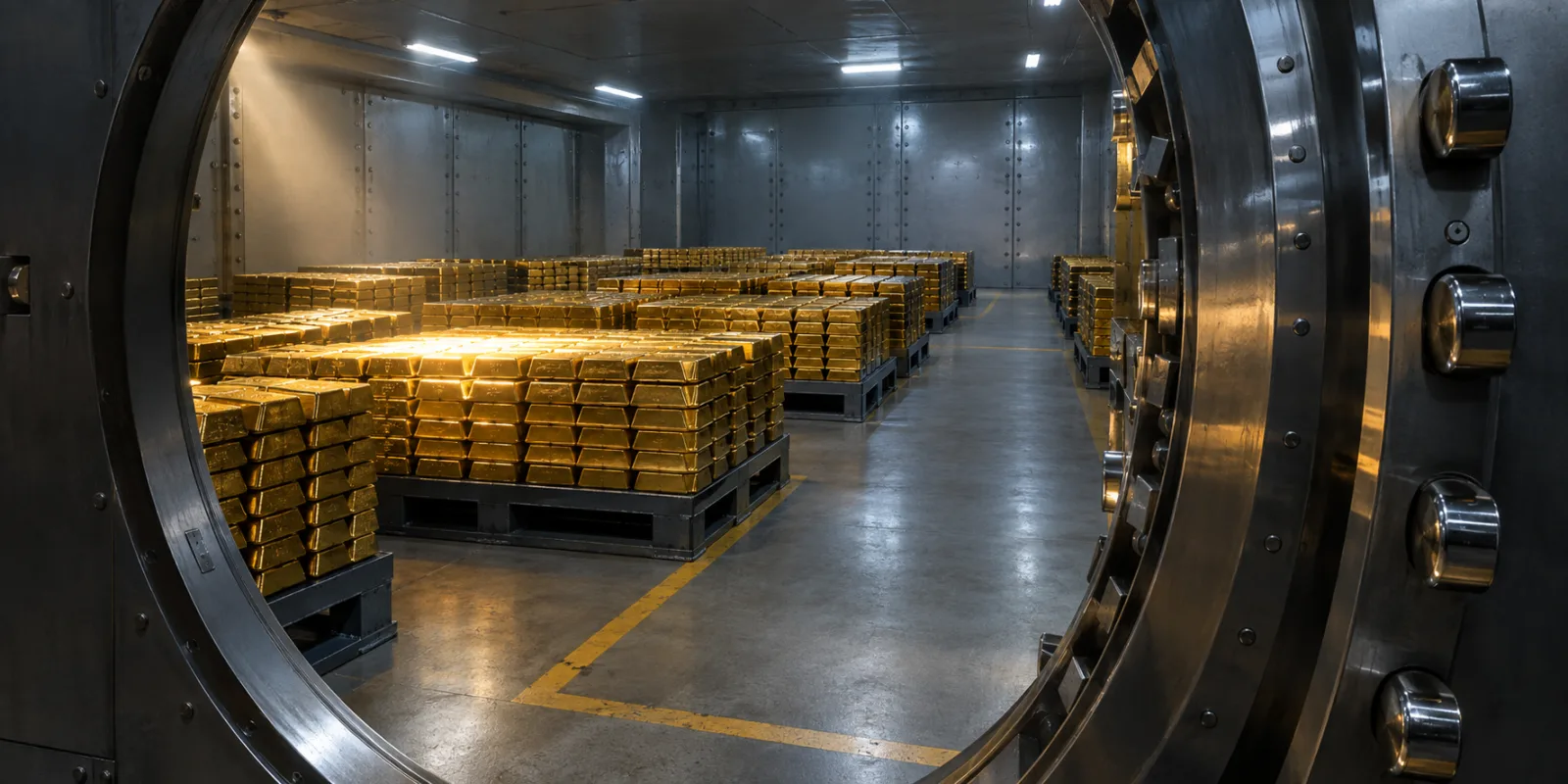
They bought more gold than ever recorded while the price was falling#
Gold hit an all-time intraday high of $5,595.47 on 29 January 2026, then fell to $3,959.33 by 24 June, a drop of more than $1,600 an ounce in five months. It was $4,329.88 on 11 September. Fund investors did the sensible thing and left, shedding 45 tonnes from gold ETFs in the second quarter.
Central banks went the other way. They bought 289 tonnes in that same quarter, 62% more than a year earlier.
That is worth sitting with. The most risk-averse institutional investors in the world increased their buying into a 29% drawdown. Either they are badly wrong about the price, or the price is not what they are solving for. The evidence points hard at the second answer. Once you see what a reserve manager is optimising for, central banks buying gold stops looking like a bet on gold at all.
What a country's reserves are actually for#
Foreign exchange reserves are the national emergency fund: assets a monetary authority holds in currencies it cannot print itself, mostly foreign government bonds, bank deposits and gold. They pay for imports, service foreign-currency debt and keep the payment system working when private lenders stop lending. Allocated reserves worldwide came to $13.10 trillion in the first quarter of 2026.
The International Monetary Fund's June 2026 handbook for reserve managers states the objective plainly. The goals are "safety, liquidity, and return in that order", and profitability "should remain the least important of the three objectives and clearly only come in third place".
That line explains most of the behaviour. A pension fund maximises return subject to risk. A reserve manager minimises the chance of being unable to act in a crisis. Different problems, and the second has an obvious place for a metal that pays no interest.
Gold's odd advantage is that it is nobody's liability. A US Treasury bond is a promise from a government, settled through infrastructure a few jurisdictions control. A bar in your own vault is a promise from nobody. Poland's central bank says as much in its published strategy: gold is "devoid of credit risk" and "not easily 'debased' by monetary or fiscal mismanagement of any country". No coupon, no issuer, nobody to ask.
What the models weigh#
Reserve managers do run real optimisations, using the strategic asset allocation frameworks, value-at-risk and expected shortfall measures and stress tests the IMF handbook describes. But the constraints do more work than the objective function, and three of them push gold up the list.
The first is liquidity, which for a central bank means crisis liquidity rather than ordinary market depth. An asset earns its place if it can be sold or pledged when everything else is falling at once. Gold's record in those windows is why 90% of surveyed central banks, a record, cited its performance during times of crisis.
The second is correlation. Most reserves already sit in dollar and euro assets, so buying more of them adds little diversification. Gold moves differently from the major reserve currencies, which is why 82% of the same respondents named portfolio diversification, and why Poland's central bank calls gold a counterweight to a reserve book that was 51% US dollars when it published that strategy.
The third is horizon. Reserve managers are not judged against a quarterly benchmark in any career-threatening way, and 84% cited gold's role as a long-term store of value. A 29% drawdown inside a holding period measured in decades is not the same event for them as for you.
This is interpretation rather than fact, but put the three together and a falling price stops being a sell signal and becomes a discount on an allocation you intended to build anyway. The World Gold Council credits the second-quarter surge partly to softer prices alongside geopolitical uncertainty.
The variable that genuinely changed#
The biggest shift in reserve management this decade has little to do with inflation or interest rates. It is about whether your reserves stay yours. The research predates the current wave. An IMF working paper by Serkan Arslanalp, Barry Eichengreen and Chima Simpson-Bell found that gold appeals "as a safe haven in periods of economic, financial and geopolitical volatility", and that financial sanctions imposed by the United States, United Kingdom, European Union and Japan are associated with higher gold shares. Multilateral sanctions mattered more than unilateral ones, because a country hit by one bloc can move into another bloc's currency. The active diversifiers into gold, the authors found, were exclusively emerging markets.
The European Central Bank reached a similar place with newer data in June 2026, reporting that the heaviest gold buyers tend to sit in regions of higher external conflict risk. Since Russia's full-scale invasion of Ukraine in 2022, China has bought over 350 tonnes, Poland 320 tonnes and Turkey 220 tonnes.
The same instinct shows up in where the metal sits. In the 2026 survey, 57% of respondents vaulted gold at the Bank of England and 49% at home, and the share planning to increase domestic storage rose to 9% from 5% a year earlier.
Poland is the clearest case. Its governor said in September 2025 that "in these difficult times of global turmoil and the search for a new financial order, gold is the only safe investment for state reserves", announcing a target of 30% of reserves in gold. Poland was the largest buyer in both quarters of 2026.
What 76 central banks said they plan to do next#
The World Gold Council surveyed 76 central banks between 5 February and 19 May 2026, its largest response in nine years. Of those, 93% now hold gold, up from 81% a year earlier. A record 45% expect their own holdings to rise within 12 months and 1% expect a fall. Looking out five years, 74% expect lower US dollar holdings, and among emerging market respondents 85% cited gold as a hedge against geopolitical risk.
China's central bank has now added gold for 22 consecutive months, including 20.2 tonnes in August 2026, its largest monthly purchase since 2023, lifting reported holdings to roughly 2,387 tonnes.
| Central bank | Q1 2026 | Q2 2026 | Direction of travel |
|---|---|---|---|
| Poland | +31t | +51t | Buying towards a 30% reserve target |
| China (PBoC) | +7t | +33t | 22 straight months of purchases |
| Uzbekistan | +25t | +16t | Consistent buyer |
| Kazakhstan | +12t | +15t | Consistent buyer |
| Czech Republic | +5t | +6t | Consistent buyer |
| Russia | −22t | −22t | Persistent seller |
| Turkey | Large sales and swaps | −4t | Tactical, partly swap-related |
| Global net total | +57t | +289t | H1 2026: +346t |
Source: World Gold Council, Gold Demand Trends Q1 and Q2 2026. Individual bank figures come from each quarter's report; the global net totals are as stated in the Q2 report, which revised the first quarter. All figures are net of sales and subject to further revision.
Look at that first column. A net 57 tonnes globally, because a few large sellers offset steady buying everywhere else. Turkey's governor described its transactions as "in the nature of gold-currency swap futures" meant to be reversed at maturity. "Central banks are buying" is a claim about a net figure produced by institutions with different problems.
Three reasons to hold the enthusiasm lightly#
Start with the headline share, which is mostly a price effect. The ECB reports that gold made up 27% of global official reserves at the end of 2025, ahead of US Treasuries at 22% and the euro at 15%, then attributes that ranking largely to valuation rather than strategic reallocation. Gold rose roughly 60% in 2025, and a rising asset gains portfolio share without anyone buying a gram.
Next, the dollar is not collapsing on the data we actually have. The IMF's reserve composition survey shows its share of allocated reserves rose to 57.13% in the first quarter of 2026, from 56.42% in the fourth quarter of 2025, with the euro slipping to 20.03%. What reserve managers expect five years out and what the quarterly data shows are two different kinds of evidence.
Finally, official buying is slowing from its peak. The ECB puts 2025 purchases at around 850 tonnes, down from over 1,000 tonnes a year between 2022 and 2024, though still far above anything seen before 2022.
There is also a bill. Gold pays nothing, and a ten-year US Treasury yielded 4.95% on 10 September 2026. Every ounce held instead of a bond is income surrendered for insurance. That can be a sound trade. It is still a trade.
Key takeaways#
- Central banks bought a record 289 tonnes in the second quarter of 2026, up 62% year on year, while gold fell from January's $5,595.47 peak towards $3,959.33 in late June.
- Reserve management optimises for safety, then liquidity, then return, in that order, per the IMF's own handbook. Gold is bought as insurance, not as a trade.
- Sanctions and conflict risk are what changed. IMF research links financial sanctions to higher gold allocations, and the ECB finds the biggest buyers sit in higher-conflict regions.
- A record 45% of the 76 central banks surveyed in 2026 plan to add gold within a year, and 93% already hold some.
- Gold's 27% share of official reserves mostly reflects its price rise, and the dollar's share of allocated reserves rose in early 2026. De-dollarisation is slower than the headlines suggest.
Frequently asked questions#
Why buy an asset that pays no interest? Because the alternative pays interest and carries counterparty and political risk. A reserve manager is buying something no government can freeze, default on or inflate away, and treating the lost yield as the insurance premium.
Does central bank buying push the gold price up? It supports it. The World Gold Council estimates that each 20 to 30 tonnes of demand above the long-run average of roughly 600 tonnes a year is associated with about 1% of upward price pressure. A contribution, not a floor.
Is this the end of the dollar as a reserve currency? Not on current data. The dollar was 57.13% of allocated reserves in the first quarter of 2026, higher than the quarter before. Most surveyed reserve managers expect a smaller share within five years, but an expectation is not a measurement.
Which countries are buying most? Poland, China, Uzbekistan and Kazakhstan led the first half of 2026. Russia was the largest seller.
Does any of this mean ordinary savers should buy gold? It does not follow, and this article makes no recommendation. A central bank has no retirement date, no tax bill and no need to sell in a bad year. Its reasons are not automatically yours.
Glossary#
Foreign exchange reserves: assets a central bank holds in currencies it does not issue, used to pay for imports, service foreign debt and steady its currency.
Allocated reserves: the share of world reserves whose currency composition is reported to the IMF and published quarterly in its COFER database.
Counterparty risk: the risk that the other side of a financial claim fails to pay or has its obligation blocked. Physical gold held domestically has none.
Strategic asset allocation: the long-run reference portfolio a reserve manager targets and is measured against.
Gold swap: an exchange of gold for currency with an agreement to reverse it later. It can cut reported holdings without the metal being sold outright.
Tonne of gold: 1,000 kilograms, about 32,151 troy ounces. At $4,300 an ounce, roughly $138 million.
De-dollarisation: a gradual shift in global reserves, trade invoicing or payments away from the US dollar.
This is reporting, not investment advice. Figures attributed to named sources are facts as those sources published them. Sentences weighing those figures are interpretation, and are flagged.
References#
- World Gold Council, Gold Demand Trends Q2 2026: Central Banks (Q2 net purchases, buyer and seller breakdown, first-half total).
- World Gold Council, Gold Demand Trends Q2 2026 (total demand, ETF outflows, average LBMA price).
- World Gold Council, Gold Demand Trends Q1 2026: Central Banks (Q1 buyers and sellers, Turkish swap commentary).
- World Gold Council, Gold Mid-Year Outlook 2026: Point break (January record, June low, year-to-date performance, tonnage sensitivity estimate).
- World Gold Council, Central Bank Gold Reserves Survey 2026 (sample size, fieldwork dates, expectations, vaulting preferences).
- World Gold Council, Central banks set to step up gold buying over the next year (ranked reasons for holding gold, headline survey statistics).
- International Monetary Fund, Foreign Reserves Management, Part I, MCM Technical Assistance Handbook, June 2026 (objectives hierarchy, risk measures, strategic asset allocation).
- International Monetary Fund, Currency Composition of Official Foreign Exchange Reserves data brief, 1 July 2026 (dollar and euro shares, total allocated reserves).
- Serkan Arslanalp, Barry Eichengreen and Chima Simpson-Bell, Gold as International Reserves: A Barbarous Relic No More?, IMF Working Paper 2023/014 (sanctions and gold allocation findings).
- European Central Bank, The international role of the euro, June 2026 (gold's share of official reserves, 2025 purchase volumes, conflict-risk analysis).
- Narodowy Bank Polski, Gold as a pillar of NBP's reserve management strategy (stated rationale for holding gold, dollar share of reserves).
- MINING.COM, Polish central bank increases gold holdings target to 30% of reserves, 11 September 2025 (governor's statement and target).
- Kitco News, China's central bank buys 20.2 tonnes of gold in August, 8 September 2026, reporting State Administration of Foreign Exchange data.
- Federal Reserve Bank of St Louis, 10-Year Treasury Constant Maturity Rate (DGS10) (yield as of 10 September 2026).
- Forbes Advisor, Gold Price Today, 11 September 2026 (spot price of $4,329.88 an ounce and 52-week range).