Algo Trading Without a PhD: The AI Strategies Retail Traders Really Run
Retail algorithmic trading has never been cheaper to start. Here is what ordinary traders actually run, what the evidence says about the results, and where the regulators stop.
The code got cheap. The edge did not.#
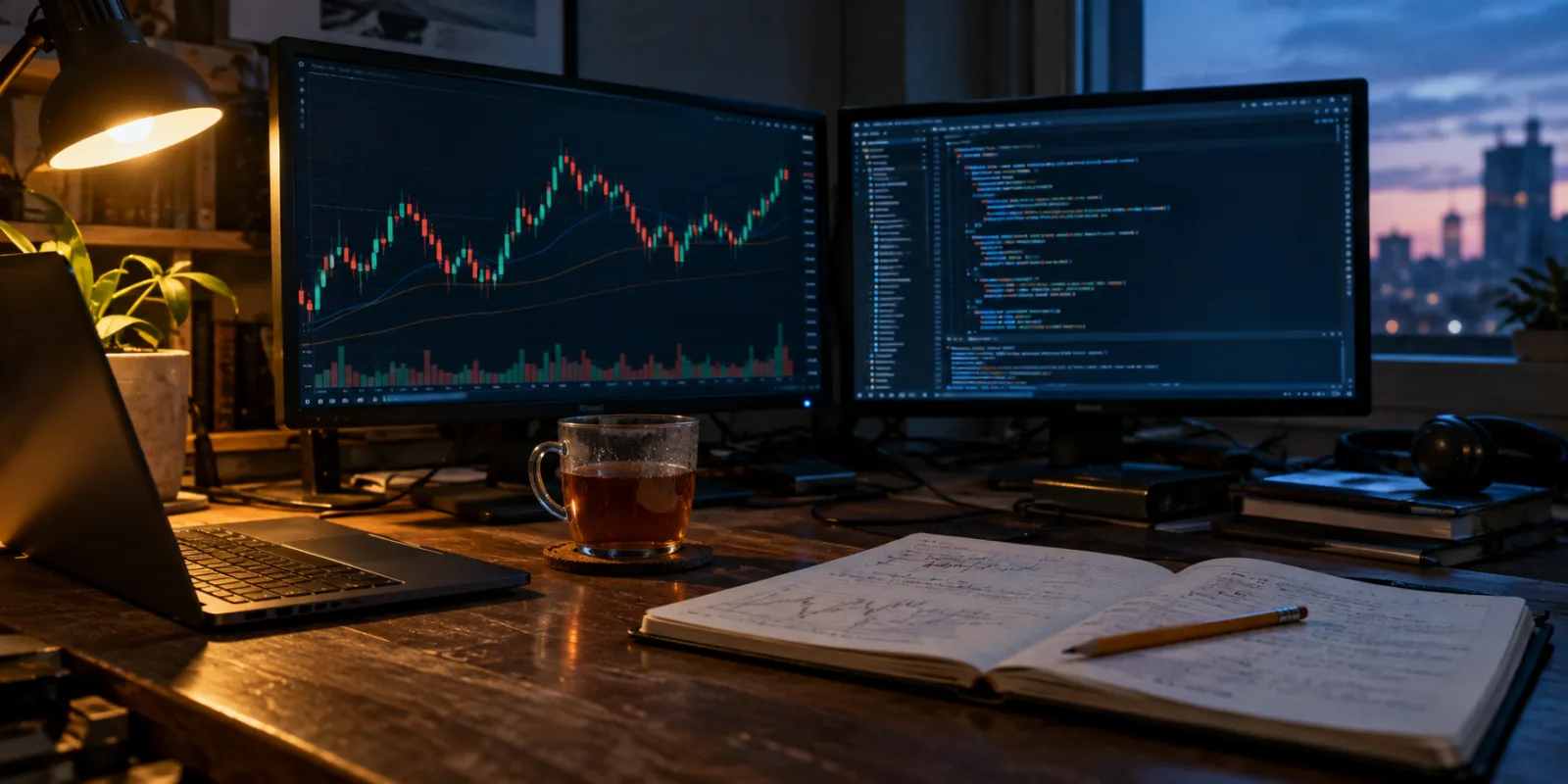
Ten years ago, automating a trading strategy meant knowing C++, paying for market data and negotiating with a broker over connection permissions. Now a free research account will backtest an idea across years of equity, futures and crypto prices at no charge, and a chatbot will draft the Python before your coffee goes cold.
The barrier really has fallen. The arithmetic underneath it has not moved at all.
Regulators spent the past year writing rules for professionals. FINRA's 2026 oversight report, published in December 2025, warns member firms about AI agents that "act autonomously without human validation and approval". ESMA followed with a supervisory briefing on algorithmic trading on 26 February 2026. Neither says much about someone running a bot from a spare bedroom, because that person sits outside the supervisory perimeter. Every safeguard a bank is required to build, you build yourself or go without.
What algorithmic trading actually means#
An algorithm here is a set of rules precise enough for a computer to follow without asking questions. Buy when the 50-day average price crosses above the 200-day average. Risk 1% of the account per position. Sell if price falls 3% below entry. That is algorithmic trading, with no artificial intelligence and no doctorate involved.
Three terms cause most of the confusion. A backtest runs your rules over historical prices to show what would have happened. An API, or application programming interface, is the doorway a broker opens so your software can submit orders instead of you clicking. An expert advisor, or EA, is a packaged bot written for the MetaTrader platforms that dominate retail forex.
Worth separating out: a robo-adviser is not an automated trading system. It spreads money across index funds and rebalances occasionally, without trying to time anything.
Machine learning enters when a model is fitted to data rather than written by hand. That is harder, because a model that learns from the past can learn things that were only ever true of the past.
The five automated strategies retail traders are actually running#
Strip away the marketing and retail automation falls into a few recognisable shapes.
| Approach | What it does | Typical entry cost | Where it usually breaks |
|---|---|---|---|
| Trend following (crossovers, breakouts) | Buys strength, sells weakness, holds for days or weeks | Free on charting platforms; broker API access usually free | Long runs of small losses in sideways markets. Most traders quit before the rare large winner arrives |
| Mean reversion (oscillator entries) | Buys short-term weakness expecting a bounce | Free to code, needs intraday data | One sustained trend against the position erases months of small gains |
| Grid bots (mostly crypto) | Places a ladder of orders across a price range | Built into major exchanges at no upfront charge | Earns inside the range, loses once price leaves it |
| Bought expert advisors (MetaTrader) | A stranger's compiled strategy, rented or bought | Roughly $79 to $1,999 on the MQL5 Market, most $299 to $499 | You cannot inspect the logic or count the versions discarded before this one |
| Copy trading | Mirrors another person's live trades into your account | No fee to the copier on most platforms, spreads still apply | You inherit the leader's risk appetite without their capital base or exit plan |
Copy trading is much the largest by user numbers. eToro reported 3.81 million funded accounts and $18.5 billion in assets under administration for the fourth quarter of 2025, and confirmed the service had launched in the United States. ESMA has told national regulators that copy trading generally qualifies as a regulated investment service under MiFID II rather than a social feature.
Why the backtest looks better than the account#
Bailey, Borwein, López de Prado and Zhu demonstrated in the Notices of the American Mathematical Society in 2014 that "high simulated performance is easily achievable after backtesting a relatively small number of alternative strategy configurations". They named the effect backtest overfitting. Test enough variations of a rule against the same history and one will look brilliant through luck alone. In a companion paper on the probability of backtest overfitting, the same authors point out that a 5% false-positive rate "only holds when we apply the test exactly once".
Falling into this does not require billions of trials. Nudging a moving average from 50 days to 48 because the equity curve looks tidier is a trial. So is quietly dropping the year that ruined the results. A strategy tuned that way is not a discovery about markets, only a description of one stretch of history.
The same reasoning applies to anything sold with a performance chart attached, including most expert advisors and every AI trading bot advertised on social media. The vendor tested many configurations and shows you the survivor. The failures are not in the brochure.
The costs nobody puts in the simulation#
Simulations fill orders at the price on the chart. Real accounts do not.
Every trade pays a spread, frequently a commission, and often financing and slippage too. A strategy trading twice a day meets those costs roughly 500 times a year. Research on active retail trading is consistent about how large that gap gets.
Barber, Lee, Liu and Odean went through the complete record of Taiwanese day traders from 1992 to 2006 and found "less than 1% of the day trader population is able to predictably and reliably earn positive abnormal returns net of fees". Around 450,000 people day traded in a typical year; about 4,000 profited dependably after costs.
Brazil produced much the same picture. Chague, De-Losso and Giovannetti tracked everyone who began day trading equity futures between 2013 and 2015 and found 97% of those who persisted beyond 300 days lost money, with 1.1% earning more than the Brazilian minimum wage.
Neither study is about algorithms specifically, which is the point. Automation changes who presses the button. It does not change the spread, and it lets a losing strategy trade more often rather than less.
Leverage makes all of this considerably worse. ESMA found in March 2018 that between 74% and 89% of retail accounts typically lost money on contracts for difference, with average losses per client between EUR 1,600 and EUR 29,000. Most retail forex and CFD bots run on exactly those products.
Where the rulebook reaches, and where it stops#
Institutions are covered. IOSCO's March 2025 report on AI in capital markets found 63% of surveyed broker-dealers using AI in algorithmic trading, and set out the worries that follow: model drift, weak explainability, herding when many firms run similar models, and dependence on a few third-party providers.
Individuals are not, and the gap shows up in fraud statistics rather than market-structure ones. The CFTC warns that promoters of AI trading bots advertise guaranteed monthly returns of 10% or more and win rates of 100%, neither of which exists. Its advisory cites Mirror Trading International, whose operator defrauded more than 23,000 people of $1.7 billion in bitcoin while claiming an automated strategy that was really a Ponzi scheme. The SEC, NASAA and FINRA issued a joint investor alert on AI and investment fraud in January 2024.
Registered firms have been caught inflating their AI claims too. In March 2024 the SEC fined Delphia and Global Predictions a combined $400,000 for what it termed AI washing. Global Predictions had marketed itself as the "first regulated AI financial advisor". Then-chair Gary Gensler was blunt: "Investment advisers should not mislead the public by saying they are using an AI model when they are not."
If a firm with a compliance department gets this wrong, an anonymous account selling a bot on Telegram deserves rather more scepticism than it usually receives.
Key takeaways#
- Access is solved. Profitability is not. Free backtesting, free broker APIs and AI-assisted coding removed the technical barrier, and none of the evidence on retail outcomes moved with it.
- A good backtest is weak evidence. Testing a modest number of configurations produces impressive simulated results by chance, as Bailey and co-authors showed in 2014.
- Costs decide most outcomes. Fewer than 1% of Taiwanese day traders earned reliable abnormal returns after fees, and 97% of persistent Brazilian day traders lost money.
- Leverage amplifies whatever the strategy already does. ESMA measured retail CFD loss rates of 74% to 89%, and most retail forex bots trade those products.
- Nobody supervises your bot. FINRA and ESMA write rules for firms. Position sizing and a hard shutdown rule are yours to enforce.
This article is information, not investment advice. Automated trading can lose money quickly, including more than the amount deposited when leverage is involved.
Frequently asked questions#
Do I need Python to run an algorithmic trading strategy? No. No-code builders and MetaTrader expert advisors require none. Python algorithmic trading is worth learning if you want to inspect what your system is actually doing.
Are AI trading bots legal? Running software on your own account is generally lawful. Selling one while promising returns is where the rules bite, and both the CFTC and the SEC have acted over inflated automation claims.
Does a longer backtest solve overfitting? It helps without solving it. What matters more is how many variations you tried before choosing the one you liked, and whether any data was held back and left untouched during development.
Is copy trading safer than running my own bot? Different, not safer. You are delegating to someone whose account size and risk tolerance you cannot see. ESMA treats copy trading as a regulated investment service for that reason.
Can machine learning predict market prices? Published results are mixed and usually reported before realistic trading costs. Treat claims of consistent prediction as marketing until someone shows out-of-sample results with costs included.
What single check would improve most retail systems? Paper trade the finished strategy for a few months without touching it. Live behaviour that drifts from the backtest usually means the backtest was fitted to noise.
Glossary#
Algorithmic trading Trading in which a computer programme decides the timing, price or size of orders by predefined rules.
Backtest A simulation of a strategy over historical data. Results depend heavily on how many variations were tried first.
Backtest overfitting Tuning a strategy until it matches past data so closely that the fit describes noise, not repeatable behaviour.
Expert advisor (EA) An automated strategy written for MetaTrader, commonly sold or rented through the MQL5 Market.
Slippage The gap between the price a strategy expected and the price it received. Usually absent from backtests, always present live.
CFD (contract for difference) A leveraged derivative tracking an asset's price without owning it. ESMA restricted retail sales in 2018.
Drawdown The fall from an account's peak value to its low, and the number most traders underestimate until they live through one.
References#
- FINRA, 2026 Annual Regulatory Oversight Report, December 2025.
- ESMA, Supervisory Briefing on Algorithmic Trading in the EU and the accompanying news release, 26 February 2026.
- ESMA, ESMA agrees to prohibit binary options and restrict CFDs to protect retail investors, 27 March 2018.
- ESMA, ESMA provides guidance for supervision of copy trading services, 30 March 2023.
- IOSCO, Artificial Intelligence in Capital Markets: Use Cases, Risks, and Challenges, March 2025.
- CFTC, Customer Advisory: AI Won't Turn Trading Bots into Money Machines.
- SEC, NASAA and FINRA, Artificial Intelligence (AI) and Investment Fraud: Investor Alert, 25 January 2024.
- SEC, SEC Charges Two Investment Advisers with Making False and Misleading Statements About Their Use of Artificial Intelligence, 18 March 2024.
- D. H. Bailey, J. M. Borwein, M. López de Prado and Q. J. Zhu, Pseudo-Mathematics and Financial Charlatanism: The Effects of Backtest Overfitting on Out-of-Sample Performance, Notices of the AMS, 61(5), 2014.
- D. H. Bailey, J. M. Borwein, M. López de Prado and Q. J. Zhu, The Probability of Backtest Overfitting.
- B. M. Barber, Y.-T. Lee, Y.-J. Liu and T. Odean, The Cross-Section of Speculator Skill: Evidence from Day Trading, Journal of Financial Markets, 2014.
- F. Chague, R. De-Losso and B. Giovannetti, Day Trading for a Living?, 11 June 2020.
- eToro Group Ltd, eToro Reports Fourth Quarter and Full Year 2025 Results, 17 February 2026.
- MQL5, Expert Advisors for MetaTrader 5, accessed 12 September 2026.
- QuantConnect, Pricing, accessed 12 September 2026.