Korea's KOSPI Crash: A Live Rehearsal for the AI Bubble Burst
Korea's KOSPI fell 41% from its June record, then jumped 17.9% in a single day, while chip exports rose 209%. Here is what the episode shows about how an AI bubble burst actually behaves.
A market fell 41% in six weeks, then rose 18% in a day#
Most of the argument about an AI bubble is conducted in the future tense. What would it look like? What would break first? Korea spent the summer answering in public.
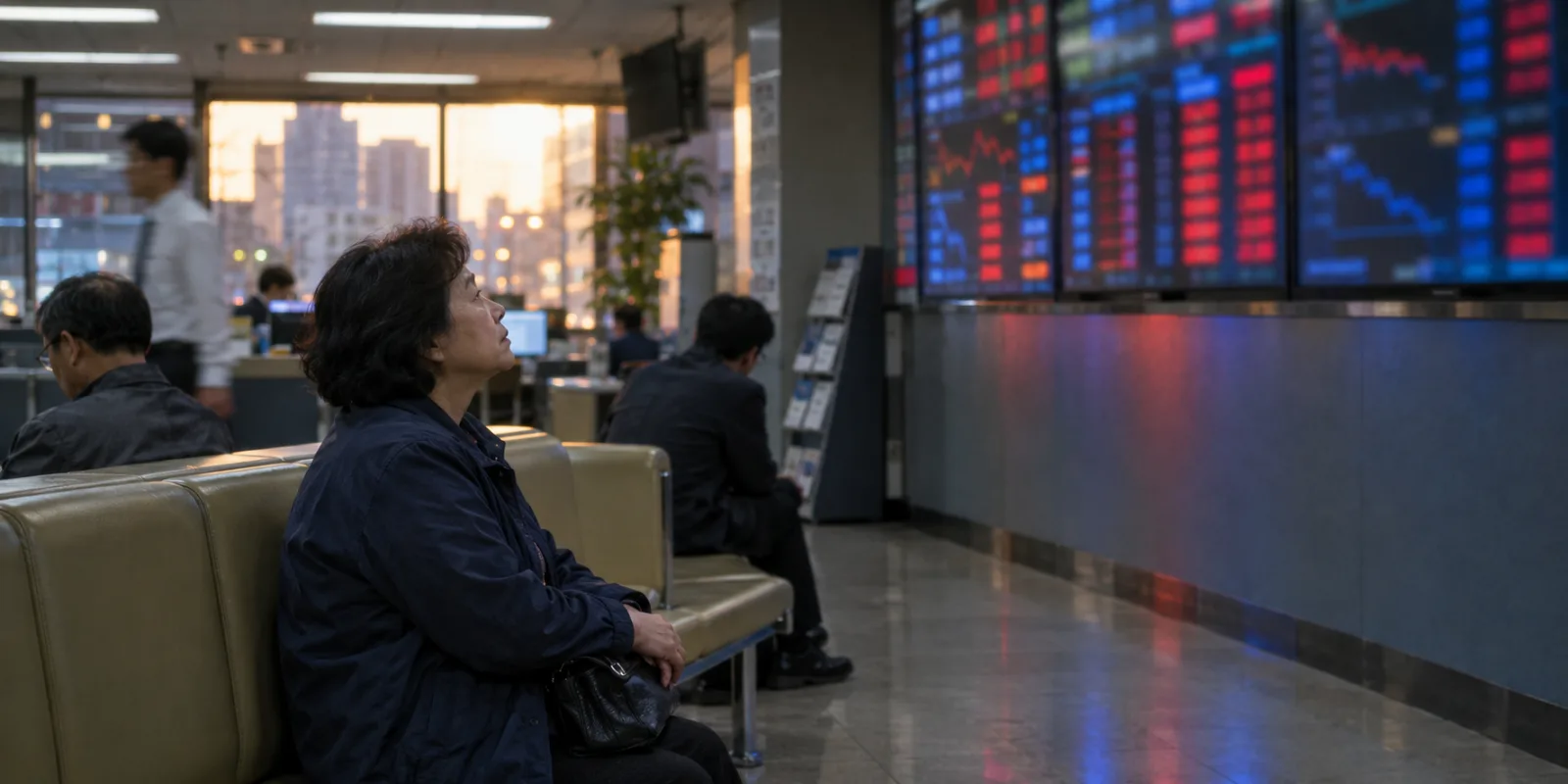
The KOSPI, Seoul's main share index, reached an all-time high of 9,385.59 in June 2026 after roughly doubling in six months, the largest advance of any major market in the world. By late July it had fallen to about 5,520, a peak-to-trough drop near 41%, including a 22.4% loss in July alone, the worst month since the global financial crisis. Then on 31 July it gained 1,001.89 points in a single session, a rise of 17.91% and the largest one-day gain in its history. It closed at 6,687.21 on Friday 4 September, still more than double where it stood a year earlier.
Now the awkward bit. While all that happened, the business underneath was booming. Korea's August semiconductor exports came to $46.65bn, up 209% on a year earlier and roughly 47.5% of total exports, on figures the Ministry of Trade, Industry and Energy published on 1 September.
Demand did not collapse. The share prices did.
Why the KOSPI became an AI index#
The KOSPI is a market-capitalisation-weighted index, meaning each company's influence is proportional to its total share value. That design is normally unremarkable. In Korea it stopped being unremarkable when two companies grew enormous.
Samsung Electronics and SK Hynix make memory chips. The AI boom needs a particular kind called HBM, or high-bandwidth memory: stacks of DRAM chips bonded together to feed AI accelerators fast enough to keep them busy. Korea's two firms dominate that market. Data centres took roughly 40% of global DRAM demand a year ago and now take more than half.
As their shares rose, so did their weight in the index. The pair made up about 22% of KOSPI market capitalisation at the end of 2023. By mid-2026 the figure was 55.5%. Buying the Korean market had quietly become a bet on two memory manufacturers, and so on how much the world's technology giants would spend on AI hardware.
Two pieces of market plumbing also matter. A circuit breaker halts trading for 20 minutes when the index moves sharply; a sidecar briefly pauses programme-driven futures orders. Both are meant to be rare. In the first half of 2026 they were not: Korea Exchange data reported in late July showed seven circuit breakers between January and 24 July, against 13 in the previous 26 years combined, plus 41 sidecar activations against 26 in the whole of 2008 and three in all of 2025.
What actually broke was borrowed money#
The trigger was not a collapse in chip demand. It was the unwinding of leverage.
Korean savers had spent the first half of 2026 buying the rally with borrowed and geared money. Leveraged exchange-traded funds, which use derivatives to multiply a daily move so a 3% fall in a share becomes a 6% fall in the fund, grew to about a fifth of Korea's 1,142 ETFs. Daily ETF turnover rose from ₩6.6trn in December 2025 to ₩34trn in June 2026. Single-stock leveraged ETFs tracking Samsung and SK Hynix were launched only in May 2026.
Retail investors put ₩78trn, about $54.2bn, into the market in May and June alone. When prices turned, the gearing worked in reverse. Tom Lee of Fundstrat Global Advisors said margin debt had risen 54% over the year, the sixth-largest such surge in six decades, and that roughly 1.2 million Korean brokerage accounts, around 10% of the total, received margin calls. A margin call is a broker demanding more cash or selling your shares. Enough at once and selling begets selling, whatever any company happens to be earning.
Nor was the borrowing confined to broking accounts. Financial Supervisory Service data shows loans secured against Korea's five largest listed stocks reached ₩2.90trn by the end of May, up 24.3% from the end of 2025, with 63% of it owed by people aged 60 and over. The savers with the least time to recover had taken on the most debt to join in.
Foreigners sold, locals bought, and both were partly right#
Foreign investors sold a net ₩148.32trn of Korean shares in the first half of 2026, about $95bn, on Yonhap Infomax figures reported by the Korea JoongAng Daily. Korean individuals bought a net ₩99.17trn and domestic institutions ₩35.05trn. On 30 June alone, foreigners sold ₩7.76trn.
Some of that was currency rather than conviction. The won weakened from 1,483.3 to 1,549.4 per dollar between May and June, eroding returns for anyone holding Korean shares in dollars.
Before the surge, Korean shares traded at a price-to-book ratio of 0.99, against 1.8 in Japan and 3.7 in the United States: the long-running "Korea discount". Below one implies the market values a business at less than its own balance sheet. Foreign money helped close that discount on the way up, then left once it had closed.
Seoul went after the product, not the price#
On 16 July the Financial Services Commission and other regulators suspended new listings of single-stock leveraged ETFs, raised the minimum deposit from ₩10m to ₩30m, lifted the minimum trading unit from one to 20, added compulsory investor training and halted promotion of the products. FSC chairman Lee Eog-weon said the higher deposit would take effect on 31 July, and that a cap limiting such holdings to 20% of an individual's portfolio was under review. Byun Je-ho, the FSC's capital market bureau director general, noted the obvious: "It's highly unusual to introduce safeguard measures a little more than a month after a product's launch."
Nobody tried to hold the index up. Officials went after the mechanism that turned a correction into a cascade. Whether that was right is a matter of judgement, but it says clearly where they thought the fragility lived.
Why this matters if you have never bought a Korean share#
The first link outward is measurable. The 60-day correlation between the KOSPI and the Nasdaq reached roughly 0.50 in late July, the highest since 2021, on figures from Rayliant Global Advisors. A correlation of 1.0 would mean the two move in lockstep, so 0.50 is high for markets on opposite sides of the world. Rayliant's research head put the reason plainly: both are "increasingly being driven by a common underlying factor, which is sentiment toward the AI hardware trade."
The second is structural. The IMF's Global Financial Stability Report of April 2026 flagged the risk of "mega-cap stocks failing to generate expected returns to justify current valuations", naming concentration and elevated valuations as sources of asymmetric downside. Korea had a more concentrated version of the index almost everyone else owns.
One watch-item has nothing to do with sentiment. TrendForce forecast on 3 July that conventional DRAM contract prices would rise 13% to 18% quarter on quarter in the third quarter, while warning that PC and smartphone buyers are "reaching their affordability limit". Memory is cyclical, and prices rising more slowly is the signal that matters. It shows up well before earnings do.
The episode in sequence#
| Date | Event | KOSPI level |
|---|---|---|
| 22 Jan 2026 | Index passes 5,000 for the first time | ~5,000 |
| May 2026 | Single-stock leveraged ETFs on Samsung and SK Hynix launch | |
| 19 Jun 2026 | Record high; the two chipmakers are 55.5% of market value | 9,385.59 |
| 30 Jun 2026 | Record daily foreign selling of ₩7.76trn | |
| 16 Jul 2026 | FSC suspends new single-stock leveraged ETF listings | |
| Late Jul 2026 | Trough; margin calls hit about 1.2m accounts | ~5,520 |
| 31 Jul 2026 | Largest one-day gain on record, +17.91% | 6,595.45 |
| 1 Sep 2026 | August chip exports reported at $46.65bn, +209% | |
| 4 Sep 2026 | Latest close, more than double a year earlier | 6,687.21 |
Sources as cited above. The June and July levels are the extremes of the move, not closing prices on those dates.
Key takeaways#
- A 41% fall happened while the export business behind it grew 209%. Price and fundamentals can separate for months, in either direction.
- Concentration was the precondition. Two companies at 55.5% of an index makes the index a sector bet wearing a national costume.
- Leverage set the speed. Geared ETFs, margin debt and share-backed loans turned a sell-off into forced selling by a tenth of all brokerage accounts.
- The rebound was as violent as the fall. One session recovered 17.91%, which is why waiting for the dust to settle is easier said than done.
- Regulators moved against product design rather than prices, a hint about where supervisors elsewhere will look.
Frequently asked questions#
Was this the AI bubble bursting?
No. It was a sharp repricing in one concentrated, heavily geared market, and the index is still more than double its level of a year ago. Whether the wider AI trade is a bubble is a separate question this episode does not settle.
If chip demand is so strong, why did the shares fall?
Share prices reflect expectations about future profits, not current sales. When enough holders are forced to sell for reasons unrelated to earnings, prices fall anyway. That is an interpretation of the evidence, not a proven account of every seller's motive.
Are these problems specific to Korea?
Partly. The concentration, the retail leverage and the currency effect were unusually extreme. The dependence on AI hardware spending is not, which is why the KOSPI and Nasdaq correlation hit a five-year high.
What would suggest the AI trade is weakening for real reasons?
Memory contract prices flattening or falling, cuts to announced data-centre spending by the large cloud companies, and monthly export growth slowing. All three appear in public data before they reach quarterly earnings.
Should I buy Korean shares now they are cheaper?
This article does not offer investment advice and cannot assess your circumstances. The evidence does show that the index is far more volatile than it was, and that borrowed money made the downside considerably worse for those who used it.
Glossary#
KOSPI The Korea Composite Stock Price Index, the main measure of the Korean share market, weighted by company size.
HBM (high-bandwidth memory) Stacked memory chips built to move data fast enough to keep AI processors working. Korean firms lead this market.
DRAM The standard memory chip in computers, phones and servers. Its price moves in cycles of shortage and glut.
Leveraged ETF A fund using derivatives to multiply the daily movement of an asset, magnifying gains and losses alike. The multiplier resets daily, so long holdings can diverge from the asset's overall move.
Margin call A broker's demand for extra cash when shares bought with borrowed money fall in value. Unmet calls trigger forced sales.
Circuit breaker An automatic halt to trading after a large index move, intended to interrupt panic.
Price-to-book ratio A share price divided by the accounting value of the company's net assets. Below one means the market values the firm at less than its books suggest.
References#
- Korea Economic Institute of America, Explaining South Korea's Stock Market Boom, 2026.
- Trading Economics, South Korea Stock Market (KOSPI), data to 4 September 2026.
- Trading Economics, South Korea Exports YoY, reporting Ministry of Trade, Industry and Energy data released 1 September 2026.
- Fortune, Crushed by Kospi rout, angry Koreans rip Lee and vow not to buy, 2 August 2026.
- Fortune, A massive margin call and 'push-button liquidity' have torched stocks, 18 July 2026.
- TradingKey, KOSPI Surged 17.9% in a Single Day, 31 July 2026.
- Korea JoongAng Daily, Foreign investors' record Kospi sell-off may continue in second half, citing Yonhap Infomax, July 2026.
- Korea JoongAng Daily, Govt to halt new Samsung, SK hynix leveraged ETFs over volatility concerns, 16 July 2026.
- The Korea Herald, Chief financial regulator vows additional measures to curb demand for leveraged ETFs, July 2026.
- Korea Exchange circuit breaker and sidecar data to 24 July 2026, as reported.
- Seoul Economic Daily, Koreans in Their 50s and 60s Pile Up Debt to Chase Stock Rally, citing Financial Supervisory Service data, 7 September 2026.
- Rayliant Global Advisors correlation analysis, KOSPI-Nasdaq Correlation Hits 5-Year High, 28 July 2026.
- International Monetary Fund, Global Financial Stability Report, Chapter 1, April 2026.
- TrendForce, AI Server Demand Continues to Support Memory Prices in 3Q26, 3 July 2026.